Knowledge
Motorized Zoom Lenses: The Complete Selection and Integration Guide
A motorized zoom lens is a machine vision lens whose magnification is changed by a motor rather than by hand, so the same optical system can move between a wide overview and a close detail view under software control. That single capability is what separates a zoom lens from a fixed focal length lens, and what separates a motorized zoom lens from a manual one. This page is the entry point to everything POMEAS has published on the category: what the families are, how to choose between them, which numbers you must fix before asking for a quote, which models are currently documented, and how the lens connects to the rest of an automated station.
It is written for engineers and integrators who are already past the first question. If you are still working out what "zoom" means compared with "magnification", start with what a motorized zoom lens is and come back here for the selection layer.
This guide is also available in 简体中文, Español, Français, Русский and العربية.
What actually separates the families
Almost every confusion in this category comes from mixing three independent questions into one. A zoom lens is defined by three separate things, and each of them can be manual or motorized:
- Magnification change (zoom). Whether the field of view can be changed at all, and whether that change is driven by hand or by a motor.
- Focus compensation. When magnification changes, the image plane moves. Whether focus is re-established by hand or by a second motor.
- Position feedback. Whether the system knows, electrically, where the zoom is. Without feedback a motorized lens is still repeatable only in the sense that it can be told to move - it cannot report where it arrived.
Fold those together and the category resolves into four families that are actually quoted in industrial projects.
The four families you will be quoted
| Family | How magnification changes | Repeatability | Typical fit |
|---|---|---|---|
| Manual continuous zoom | Operator turns the zoom ring; focus re-set by hand | Human-dependent; not machine-readable | Labs, prototyping, stations where magnification is set once per product run |
| Detented zoom | Discrete click stops at defined ratios instead of a continuous range | Repeatable to a stop, but only at those stops | Recipes that use two or three fixed magnifications |
| Motorized zoom | Motor drives the zoom axis; position command comes from the host | Repeatable and programmable; feedback closes the loop | Multi-SKU lines, automated inspection, remote or unmanned operation |
| Telecentric macro zoom | Zoom inside a telecentric optical design | As motorized or manual, but with telecentric behaviour retained | Measurement where perspective error must stay small across the magnification range |
Two clarifications that save a lot of back-and-forth. First, a detented lens is not a lower-grade continuous lens - it is a different contract with the operator. Second, telecentric macro zoom is an optical design choice layered on top of the drive choice; it is not a fourth drive type. On POMEAS lenses the zoom and focus axes are the motorized ones; aperture is set mechanically and is not a programmable axis, so do not design a recipe that assumes software aperture control.
Motorized vs manual vs fixed focal length
The three-way comparison is the one most project teams need to settle before anything else. It is less about image quality than about how the line will be operated for the next five years.
| Consideration | Fixed focal length | Manual zoom | Motorized zoom |
|---|---|---|---|
| Changing field of view | Only by moving the camera or changing the lens | By hand, at the machine | From the host computer, at any time |
| Reproducing a setting | Automatic - it never changed | Operator-dependent; needs a marking or a lock | Programmatic; can be logged and re-run |
| Recipe changeover | Lens swap and recalibration | Manual re-set plus verification | Software command, with position read-back |
| Unmanned / remote operation | Suitable | Not suitable for magnification changes | Suitable |
| Optical complexity | Lowest | Moderate | Highest - adds a drive train and a control interface |
| Integration work | Mount and focus | Mount and focus | Mount, focus, cabling, protocol, software |
If the answer to "does magnification change during a run, on a schedule we control?" is no, a motorized lens adds integration cost without adding capability. If the answer is yes - or will be yes after the next product family arrives - the motorized path is usually cheaper than the second camera it replaces. The trade-off is examined in more detail in manual vs motorized zoom lens selection and in zoom lens vs fixed focal length lens.
A five-step selection sequence
The order matters, because each step constrains the next. Working out of order is the main reason lens selection gets re-opened late in a project.
- Write the inspection requirement in FOV and defect size, not in magnification. State the horizontal field you must cover and the smallest feature that must be detected. Everything downstream follows from these two numbers. Magnification is an output of the calculation, not an input - see why magnification is not resolution.
- Fix the sensor. Sensor width and pixel size determine what magnification you can actually use, and whether the required defect spans enough pixels to be detected at all.
- Check the reality of the magnification range. Divide sensor width by FOV at each end of the range. If the required wide view needs 0.55X but the lens starts at 0.58X, the widest usable field is set by the lens, not by your requirement - the geometry of 10-4 mm FOV with 5 micron defects is a worked example of exactly this trap.
- Check the working distance against the mechanical design. Working distance, overall lens length and any rail or fold-mirror geometry have to fit the space around the part. This step is where most designs fail after the optics have been chosen - see integrating a motorized zoom lens into a station.
- Choose the drive and the control path deliberately. Continuous or detented, single or dual axis, RS-232 or SDK, and whether the host or the PLC owns the magnification command.
The six numbers to fix before you request a quote
Supplier-independent, and the fastest way to turn a vague enquiry into a comparable quotation:
- Horizontal field of view required (mm), at the widest setting you will ever need.
- Smallest defect or feature to be detected (μm), and the number of pixels it must span.
- Sensor format and active width (mm), not just the format name.
- Working distance (mm) available between the lens front and the part, plus the tolerance you can accept.
- Cycle time budget (s) for a magnification change, if magnification changes during a run.
- Environment: vibration, ambient light, temperature band, and whether an operator is present at the station.
The same six numbers appear, with the arithmetic, in the FA industrial lens selection guide and the error catalogue in industrial lens selection calculations and common errors.
Model index: what is currently documented
The table below lists the POMEAS zoom lenses whose key specifications are published. Blank cells mean the value is not published on the product page at the time of writing - confirm before designing around it.
| Model | Zoom ratio | Optical magnification | Working distance | Max sensor | Drive |
|---|---|---|---|---|---|
| LZ-650104 | 6.5:1 | 0.7X–4.5X | 82 ± 2 mm | 2/3 inch | Motorized, RS-232, closed-loop DC servo |
| LZ-650100DS9 | 6.5X | Motorized, RS-232 position feedback | |||
| LZ-650105 | 6.5X | Motorized, coaxial | |||
| LZG-63104-A | 6.5X | 0.7X–4.5X | 87 mm | Motorized, C-mount, rail | |
| LZG-63105-A | 6.5X | 0.7X–4.5X | Motorized, rail | ||
| PMS-LZL-12104-D1 | 12.5:1 | 0.58X–7.5X | 77.4 ± 2 mm | 2/3 inch | Motorized, C-mount |
| PMS-LZL-12101 | 12.5X | 0.58X–7.5X | 77.4 ± 2 mm | 2/3 inch | Manual, coaxial illumination |
| LZL-12100 | 12.5X | 0.58X–7.5X | Manual continuous | ||
| LZL-12100D15 | 12.5X | Manual, detented stops | |||
| PMS-LZME-0510M | 0.5X–1.0X | Telecentric macro zoom |
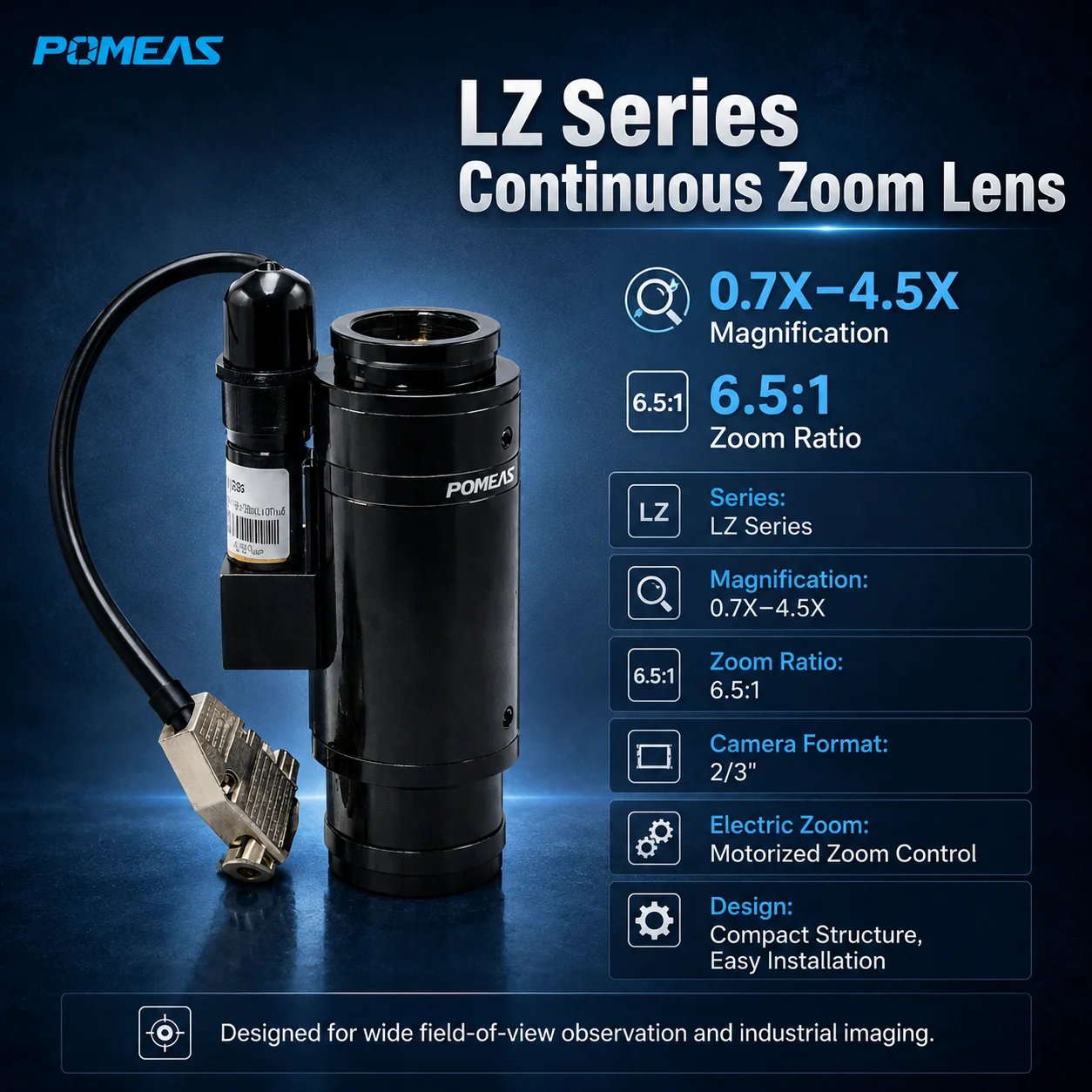
LZ-650104, a 6.5X motorized continuous zoom lens covering 0.7X–4.5X on a 2/3 inch sensor.
For the published detail on the two most commonly specified models, see the dedicated selection notes on the LZ-650104 6.5X motorized zoom lens and the 12.5X motorized zoom lens for automated inspection. The complete zoom lens listing carries the full current range.
Optical data across the four families
The model index above lists what each lens is. This table compares how they perform, because the numbers that decide a project - object-side resolution, depth of field and working distance - are the ones that differ most between families. Every value below is taken from the published datasheet for the platform, not interpolated.
| Platform | Optical magnification | Zoom ratio | Working distance | Max sensor | Finest object-side resolution | Depth of field range |
|---|---|---|---|---|---|---|
| LZ-63xxx (6.5X) | 0.7X-4.5X | 6.5:1 | 87 ± 2 mm (manual, rail) 82 ± 2 mm (motorized continuous) |
2/3 inch | 3.95 μm (3.0X-4.5X) | 1.90-0.10 mm |
| LZL-12xxx (12.5X) | 0.58X-7.5X | 12.5:1 | 77.4 ± 2 mm | 2/3 inch | 3.05 μm (4.5X-7.5X) | 2.75-0.050 mm |
| LZH-75xx (7.5X, 4K) | 0.68X-5X | 7.5:1 | 78 mm | 1 inch | not published per step | 0.15-0.027 mm |
| LZH-14105-K (14X) | 0.55X-7.6X | 14:1 | 99.7 ± 2 mm | 2/3 inch | 2.80 μm (5.0X-7.6X) | 3.16-0.04 mm |
| LZH-6805-K (68 series) | 0.7X-4.5X | 6.5:1 | 88 ± 2 mm | 1 inch | 18.32 μm (4.5X) | 12.4-0.07 mm |
| LZG / LZLG (rail) | 0.7X-4.5X / 0.58X-7.5X | 6.5 / 7.5 / 12.5 | 87 ± 2 / 77.4 ± 2 mm | 2/3 inch | 7.99 μm at 1.0X | 1.90-0.10 mm |
Three readings of that table decide most selections:
- Smallest detectable feature. The 14X platform reaches 2.80 μm object-side, the finest in the range, and it holds that value from 5X all the way to 7.6X rather than only at the top of the zoom.
- Widest single-lens span. The 12.5X family covers 18.97 mm down to 1.47 mm diagonally on a 2/3-inch sensor - a 12.9x span - which is what lets one lens locate a part and then inspect it without a second optic.
- Depth of field collapses as magnification rises. On the 6.5X platform it falls from 1.90 mm at 0.7X to 0.10 mm at 4.5X. Any height variation in the parts has to be planned around this, and it is the most common reason a lens that "should" work does not.
One caution on comparing the two 6.5:1 platforms: the rail-guided build (LZG / LZLG) resolves 7.99 μm at 1.0X where the standard body resolves 9.00 μm. That is a genuine optical difference between mechanically different builds, not a measurement artefact, and the two sets of figures should not be quoted interchangeably.
A note on terminology, because it decides whether this page is found at all. When a specification calls for a preset position, a zoom position preset or a stored inspection recipe, what is being asked for is a magnification value that can be recalled and driven back to. On these lenses that is a recorded absolute pulse position, and it is supported across the motorized range. The capability has existed for as long as the lenses have; the phrase "preset position" simply has not been used to describe it, which is why searches written in the industry's vocabulary have had nothing to match.
Control and integration: three levels of sophistication
A motorized zoom lens is only as useful as the control path behind it. There are three levels, and they are not mutually exclusive.
Level 1: serial command. The lens exposes a command set over a serial link; the host or PLC sends a position and reads back the result. This is the level at which most stations are built, and where the details matter most - cable pinout, single vs dual axis, and how pulse counts map to magnification. The command set is documented in the RS-232 serial command protocol reference, the position mapping in the pulse position to magnification table, and the wiring rules that prevent most field failures in the troubleshooting guide.
Level 2: a software development kit. Where the application needs to sequence zoom, focus and capture on its own schedule, an SDK removes the need to hand-roll the protocol. The function set and integration pattern for the POMEAS SDK are laid out in the SDK integration guide.
Level 3: closed-loop and adaptive control. Here the magnification is not merely commanded but chosen - the system measures the image and decides. This is the direction programmable optics and AI-driven optical control describe, and it depends on the repeatability established at level 1.
Whichever level you operate at, two mechanical facts govern whether the optical result stays valid over time: whether the lens remains parfocal and centred through the range, and whether the optical axis shifts when the magnification changes - the effect described in image shift after a magnification change.
Where a motorized zoom lens is the wrong answer
Naming the boundary is part of the specification, not a disclaimer.
- The requirement is fixed and always will be. If one field of view covers every product for the life of the line, a fixed focal length lens is cheaper, simpler and optically faster.
- The measurement demands telecentricity at a fixed magnification. A zoom lens trades some of the measurement stability a dedicated telecentric lens provides. If the part is measured, not merely viewed, compare against telecentric options before defaulting to zoom.
- Exposure time is already marginal. Zoom optics have more elements and a smaller relative aperture at the high end; if the station is already light-starved, adding a zoom train makes it worse.
- Nobody will ever program it. Buying the motor and driving it by hand is the most expensive way to get a manual lens.
Depth of field is the other quiet constraint. It narrows as magnification rises - on the LZ-650104 it falls from 1.9 mm at 0.7X to 0.1 mm at 4.5X - so a recipe that changes magnification is also changing the tolerance on part height. Plan the fixture around the highest magnification you will use, not the lowest.
The knowledge base behind this page
This category is documented in depth. The entries below are grouped the way a project actually moves.
Understand the category
What is a motorized zoom lens ·
Zoom vs magnification: what is the difference ·
Magnification is not resolution ·
Manual vs motorized zoom lens ·
Zoom vs fixed focal length
Select the right lens
FA industrial lens selection guide ·
Selection calculations and common errors ·
10–4 mm FOV with 5 µm defects ·
LZ-650104 selection and integration
Control and program the lens
RS-232 command protocol ·
Pulse position to magnification ·
SDK integration guide ·
Programmable optics ·
Programmable optics for AI vision ·
AI control of zoom and focus
Integrate and maintain it
Integrating a motorized zoom lens into a station ·
Integration into AI vision equipment ·
Parfocality and centring adjustment ·
Parfocality and repeatability FAQ ·
Image shift after a magnification change ·
Troubleshooting four fault classes
See it applied
Seven machine vision applications ·
Electronics and semiconductor inspection ·
Chip OCR inspection case ·
Equipment integration record ·
Fold-mirror integration case study ·
Building a motorized digital microscope ·
Liquid lens vs motorized autofocus ·
From microscope to machine vision ·
Converting a 400X microscope specification
Frequently asked questions
Is a motorized zoom lens more accurate than a manual one?
Not optically - the glass is often the same. The accuracy difference is in repeatability and traceability. A motorized lens can return to a commanded position and report where it is, so the same inspection recipe produces the same field of view next week. A manual lens reproduces a setting only as well as the operator's hand and the markings on the barrel.
What does the zoom ratio actually tell me?
It tells you the ratio between the widest and the narrowest setting, not the magnification itself. A 6.5:1 lens covering 0.7X to 4.5X is the same statement twice. What matters for a project is the absolute magnification range, because that decides whether your required field of view fits at the wide end and whether your smallest defect resolves at the narrow end.
Can I control the aperture from software?
On POMEAS motorized zoom lenses, the motorized axes are zoom and focus. Aperture is set mechanically. Do not design a control sequence that assumes software aperture control; if the application needs it, raise it as a requirement before the lens is specified.
What interface does a motorized zoom lens use?
The common industrial path is a serial interface - on POMEAS lenses a 9-pin RS-232 link, single or dual axis - with a documented command set and position feedback. Applications that need tighter sequencing on their own schedule typically use the vendor SDK rather than driving the protocol directly.
Do I need a motorized focus axis as well as zoom?
That depends on whether magnification changes during a run. Changing zoom moves the image plane, so focus has to be re-established each time. If the operator changes magnification once per shift, a manual focus is workable. If the recipe changes magnification between parts, driving focus from software removes a manual step from the cycle and from the operator's error budget.
Will a zoom lens replace my microscope?
Only if the requirement is written in machine vision terms first. A microscope magnification figure such as 400X does not translate into a lens magnification - it has to be converted into field of view, sensor size and resolvable feature first, and the answer is usually a small magnification. That conversion is set out step by step in microscope 400X vs machine vision magnification.
How many preset positions can a motorized zoom lens store?
As many as the host application stores. The lens is addressed by absolute pulse position, so a preset zoom position is a recorded pulse value - the practical limit sits in the controlling software, not in the lens.
Which POMEAS models support a 1-inch sensor?
The 7.5X 4K family (LZH-75xx) and the 68-series 6.5X platform (LZH-6805-K). Every other family in the zoom lens range is specified up to a 2/3-inch sensor.
Is the 12.9x field-of-view span available on every model?
No. It is specific to the 12.5X family, whose telecentric path covers 18.97 mm down to 1.47 mm diagonally on a 2/3-inch sensor.
Which platform gives the smallest detectable feature?
The 14X platform, at 2.80 micrometre object-side resolution, and it holds that figure from 5X to 7.6X rather than only at the top of the range.
What is the difference between motorized zoom and digital zoom?
Motorized zoom moves lens groups, so object-side resolution genuinely improves as magnification rises. Digital zoom crops and enlarges pixels and adds no optical information. One magnifies information; the other magnifies pixels.
Can a motorized zoom lens be used where parts vary in height?
Depth of field narrows sharply as magnification rises - from 1.90 mm at 0.7X to 0.10 mm at 4.5X on the 6.5X platform - so height variation has to be designed around. Parts of varying height usually need either a wider depth of field or a focus axis that is driven between parts.
Next step
If you have the six numbers listed above, a selection can be answered directly. If you are still deciding whether the category applies to your station, the fastest route is to describe the part, the field of view and the smallest defect - the configuration follows from those three. Send the requirement through the contact form, or start from the zoom lens product listing if you already know the model family you need.
Other language versions of this guide
The same guide is available in these languages:
- 电动变倍镜头选型与集成指南:倍率、视野、控制、对焦与重复定位 — 简体中文
- Guía completa del objetivo zoom motorizado: selección, control e integración — Español
- Guide complet de l'objectif zoom motorisé : sélection, contrôle et intégration — Français
- Моторизованный зум-объектив: полное руководство по выбору, управлению и интеграции — Русский
- الدليل الشامل لعدسة الزوم المحرّكة: الاختيار والتحكم والدمج — العربية

Subscribe to Our Newsletter
Simply enter your email to receive the latest news and insights from Pomeas. Stay connected with Pomeas and be the first to discover new innovations in optical excellence.