Knowledge
Programmable Optics for AI Vision: Motorized Zoom, Adaptive FOV and Autofocus
Most machine vision lenses are mechanical: an operator turns a ring, the field of view changes, and the camera keeps shooting whatever happens to be in focus. A programmable optic inverts that relationship. The lens becomes an addressable part of the machine — the same software that runs the AI model also decides the magnification, the field of view and the focus position, frame by frame and recipe by recipe. This page explains what that means in practice for AI vision equipment and AOI machines: what programmable optics is, what "adaptive" FOV, magnification and focus actually adapt to, what an optical recipe looks like, and why a motorized zoom lens is usually the enabling hardware behind all of it.
What is programmable optics?
Programmable optics is an optical system whose imaging parameters — magnification, field of view, focus position — can be changed under software control, repeatably and without touching the hardware. The word "programmable" is doing real work here: it means the optic exposes an interface (commands, positions, statuses) that a controller — a PC application, a PLC, or an embedded vision controller — can call as part of its normal program flow.
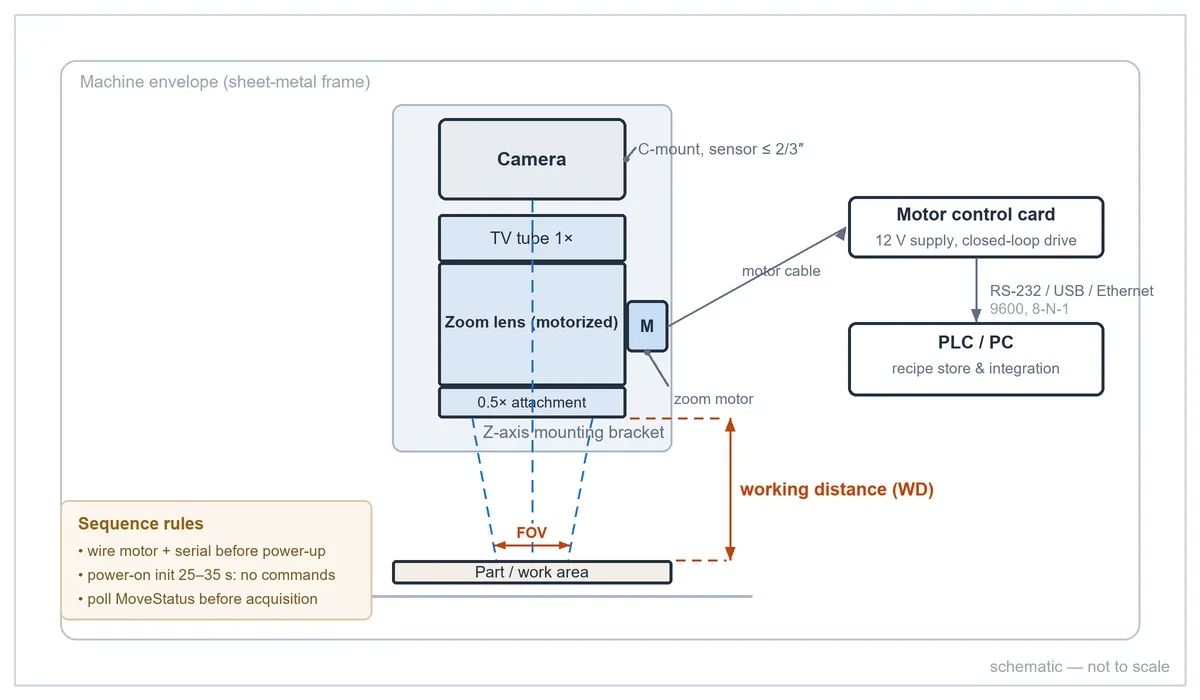
On a POMEAS motorized zoom lens, that interface is concrete: a closed-loop motor drives the zoom group, a control card connects over RS-232, USB or Ethernet, and the controller reads back position and status. The zoom lens becomes, in effect, another axis on the machine — one that changes image scale instead of moving a part.
A useful way to bound the term: what can actually be programmed on a zoom lens — and what cannot. Magnification and focus are programmable; aperture is not (the iris stays a mechanical setting); and "programmable" never means digital zoom, which only crops pixels that the sensor has already captured.
The three adaptive capabilities
Vendors use the word "adaptive" loosely. In an AI vision context it is worth pinning down the three distinct capabilities, because each one solves a different production problem.
Adaptive magnification
Adaptive magnification means the optical magnification changes on command, not by swapping lenses. A 6.5:1 motorized zoom lens such as the LZ-650104 spans 0.7X to 4.5X continuously — a 6.5-fold change in image scale on one camera. A 12.5X model such as the PMS-LZL-12104-D1 spans 0.58X to 7.5X. Because the change is optical, resolution scales with it: the LZ-650104 resolves 11.18 μm at 0.7X and 3.95 μm from 3.0X up, on cameras up to a 2/3-inch sensor.
For an AI inspection program this matters most during model bring-up and SKU changeover. One camera with adaptive magnification covers what would otherwise be several fixed-magnification stations — and new part variants are absorbed by a new magnification preset instead of a mechanical rebuild. That is the core argument in our multi-SKU changeover FAQ.
Adaptive FOV
Adaptive FOV (field of view) is the system-level consequence of adaptive magnification. On a fixed sensor, FOV and magnification are locked together by a simple relation: FOV = sensor dimension ÷ magnification. Drive the magnification and you drive the FOV. On the LZ-650104 with a 2/3-inch sensor, the diagonal FOV runs from 15.71 mm at 0.7X down to 2.44 mm at 4.5X — a continuous span, not two fixed fields.
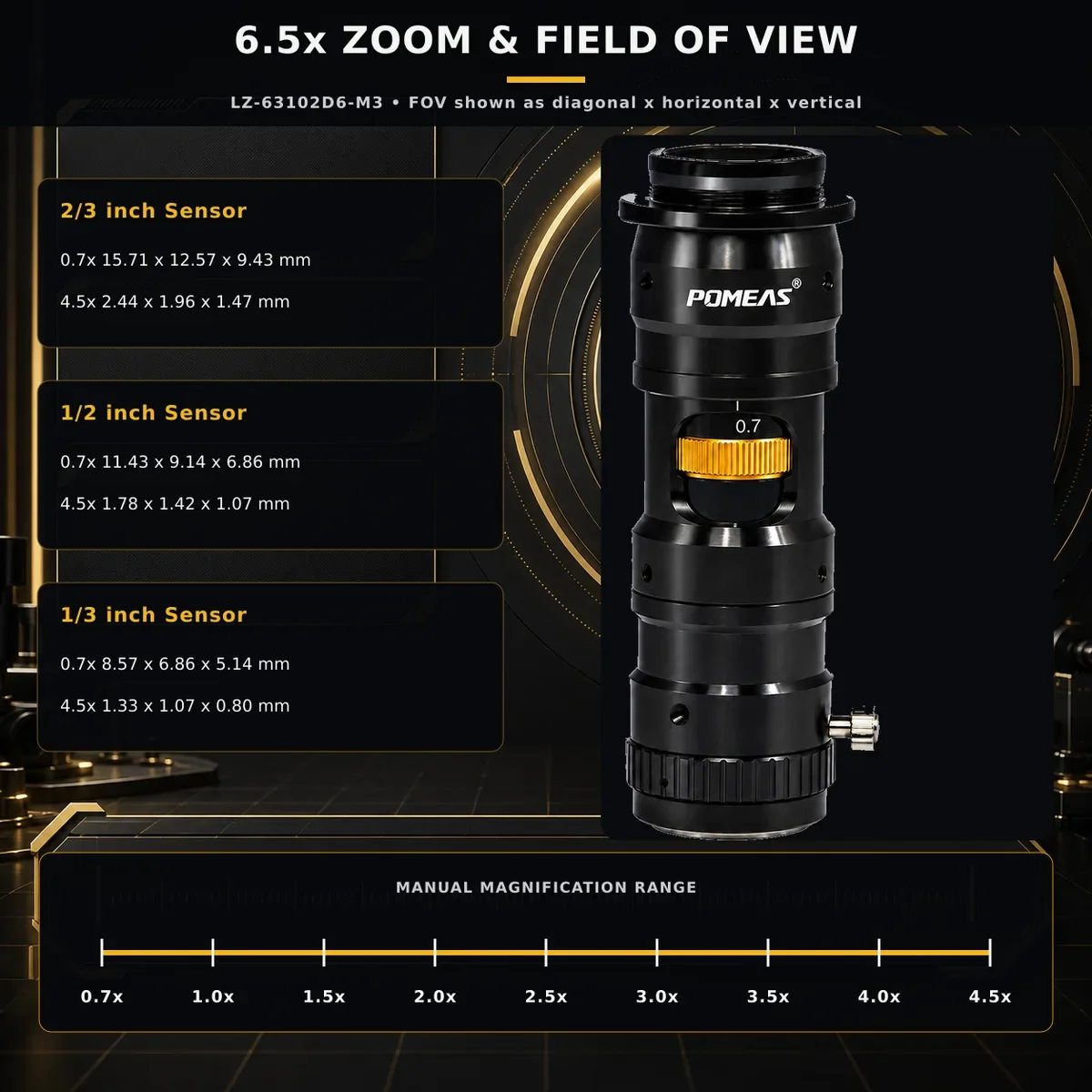
Why an AI machine wants this: wide for search, narrow for judgment. A localization model can run at 0.7X where the FOV is wide and depth of field is forgiving; once the region of interest is found, the controller drives the magnification up and the same sensor now samples the defect across more pixels. The alternative — a fixed FOV wide enough to cover the whole part — starves the AI model of resolution exactly where it needs it, or forces a second camera and a second calibration.
Adaptive focus
Adaptive focus means the focus position is a controlled output, not a fixed mechanical adjustment. Two hardware tiers exist across the POMEAS range:
- Parfocal zoom, fixed focus. On parfocal models the working distance holds while magnification changes, so focus is set once at installation and never touched. The LZ-650104 holds an 82 ± 2 mm working distance across its whole zoom range.
- Dual-motor models. A second motor drives the focus group as an independent axis. The PMS-LZL-12110-Z12 exposes exactly this: dual-motor control over RS-232/USB, with single-axis or dual-axis control modes. The focus axis can then be driven by a vision routine — a contrast-maximizing autofocus loop implemented in the controller, not inside the lens.
The honest framing — consistent with how we describe it everywhere on this site — is that an autofocus zoom lens in industrial vision is integrable, not built-in: the lens gives you a programmable focus axis, and your vision software closes the loop. There is no hidden AF module that focuses for you out of the box. See the liquid lens vs motorized autofocus FAQ for why a motorized optical axis usually wins on resolution and aperture in machine vision.
Optical recipes: making the optics part of the recipe
Once magnification and focus are addressable, they belong in the recipe layer of the machine — next to part programs, lighting channels and inspection parameters. In practice an optical recipe is a small record per product or per inspection step:
- Zoom position — a motor position in the lens's own coordinate system. POMEAS lenses map pulse positions to magnification; the 65 series, for example, travels roughly 0 to 24,400 pulses from minimum to maximum magnification, with the exact total varying unit to unit (the full mapping is in the pulse position table).
- Focus position — on dual-motor models, a second axis value; on parfocal models, a fixed installation setting.
- Expected status window — the controller polls the lens until the move completes before the vision system triggers acquisition. The control API reports moving / idle / error states precisely so the recipe can be deterministic.
Because positions are closed-loop, a recipe recall is repeatable: command the same position, get the same magnification, within the repeatability the mechanism holds. That repeatability is what lets the same trained model run unchanged after changeover — the image geometry comes back to where the model expects it. Calibration and parfocality procedure are one-time installation work, documented step by step in the parfocality and centering SOP.
Why AI vision and AOI equipment need a motorized zoom lens
Four pressures keep coming up in AI inspection projects, and each one pushes toward a motorized zoom lens for AI vision equipment:
1. Resolution is the bottleneck, not field of view
AI models fail at the pixel budget: a 0.05 mm defect on a part imaged at 30 mm FOV occupies too few pixels to classify reliably. Fixed optics force a compromise between "see the whole part" and "resolve the defect". Adaptive magnification removes the compromise by sequencing: wide field to find, narrow field to judge — the same sensor, the same camera, seconds apart.
2. Model portability across SKUs
AI inspection lines live or die by changeover cost. When optics are programmable and recipes are stored, a new variant is a recipe entry, not a re-engineering session: recall zoom position, verify reference image, run. Machines that require an operator to swap lenses or re-focus manually end up training a new model per station, which multiplies validation work.
3. The locate-then-measure workflow
Almost every AOI program has the same shape: acquire wide, run localization, then inspect regions of interest at high magnification. A motorized zoom lets both steps share one optical path — the AOI motorized zoom lens is driven between the two positions by the machine program, with no operator in the loop.
4. Digital zoom is not optical magnification
It is worth restating because it keeps resurfacing in AI projects: cropping a 12 MP image does not create detail; it interpolates pixels. Optical magnification changes the image scale before the sensor, so the defect genuinely projects across more photosites. The distinction — and the terminology trap around "zoom ratio" vs magnification — is covered in zoom vs magnification.
What the hardware looks like
A programmable optics chain has four parts, all documented in the POMEAS motorized zoom lens overview:
| Element | Role | Example |
|---|---|---|
| Motorized zoom lens | Continuous optical magnification, parfocal or dual-motor | LZ-650104 (0.7X–4.5X), PMS-LZL-12104-D1 (0.58X–7.5X) |
| Control card | Closed-loop motor drive, position readback, dual-axis support | POMEAS motor control card, 12 V supply |
| Link to controller | Serial, USB or Ethernet; a PLC-controlled zoom lens typically sits on RS-232 | 9-pin RS-232 on the LZ-650104; RS-232/USB on the Z12 |
| Software interface | SDK calls: open, home, goto position, read status, read travel | PMSOpticDll — see the SDK integration guide |
Two integration realities worth knowing before specifying: the lens completes a 25–35 s initialization after power-up during which it cannot be commanded, and the controller should treat "move complete" as a polled status rather than a fixed delay. Both are covered, with the full call sequence, in the SDK guide.
Choosing a lens for a programmable optics application
The selection questions are the same as for any zoom lens, with two extra ones for programmability:
- Magnification span and resolution at both ends — check the resolution and distortion tables at the extremes, not just the zoom ratio.
- Sensor size and mount — the range above supports up to 2/3-inch sensors on C-mount.
- Working distance vs installation envelope — bare-lens WD (82 ± 2 mm on the LZ-650104) is not the same as module WD once TV tubes and attachments are added; the integration guide works a full example.
- Parfocal or dual-motor — parfocal where the part height is stable; dual-motor where focus must track or be verified per recipe.
- Control path — who commands the lens: PC application (SDK), PLC (serial protocol), or both in sequence.
- Recipe depth — how many distinct magnification positions the application actually needs, and whether each needs a stored focus reference.
For a real worked example of these decisions in an AI inspection machine, see the fold-mirror integration case: CAD envelope verification, drawing cross-check and as-built measurement of a 65-series motorized zoom module.
Frequently asked questions
What does "programmable optics" mean on an industrial zoom lens?
That magnification — and on dual-motor models, focus — is driven by software commands with position readback, so the controller can change imaging parameters as part of its program, repeatably and without manual adjustment.
Is adaptive FOV the same as digital zoom?
No. Adaptive FOV changes the optical magnification before the sensor, so resolution scales with the view. Digital zoom crops existing pixels and loses detail. The FOV relation is simply sensor size divided by magnification.
Can a PLC control the zoom lens?
Yes. The control card speaks serial (RS-232) or Ethernet, and the command set covers position moves, homing and status polling — the documented protocol is in the RS-232 command reference. Many machines drive the lens from the PLC for recipe recall and from a PC application for setup.
Does POMEAS offer an autofocus zoom lens?
Dual-motor models such as the PMS-LZL-12110-Z12 provide a second, programmable focus axis over RS-232/USB. Autofocus itself is implemented by your vision software — typically a contrast-maximization loop that drives the focus axis — so it is an integration capability rather than a built-in AF module.
How repeatable is a stored magnification position?
Zoom positions are closed-loop motor positions, so a recipe recall returns the same magnification within the mechanism's repeatability. Exact pulse totals vary unit to unit, which is why recipes should store positions learned on the installed lens, not table values.
Need help integrating programmable optics into your AI vision equipment?
Send us your application parameters and we will map them to a lens and control chain:
- Camera model and sensor size
- Required FOV range (widest and finest)
- Working distance and available installation space
- Smallest feature or defect to resolve
- Control requirements (PLC, PC, or both)
Related reading

Subscribe to Our Newsletter
Simply enter your email to receive the latest news and insights from Pomeas. Stay connected with Pomeas and be the first to discover new innovations in optical excellence.