Knowledge
FA Industrial Lens Selection Guide: Sensor Size, FOV, Working Distance and Inspection Accuracy
1. Quick Answer
Quick answer: An FA industrial lens is commonly used in machine vision applications such as presence detection, appearance inspection, positioning, recognition, barcode reading, OCR and general dimensional checking. To choose the right FA lens, you should not start only from focal length. You should first confirm the camera sensor size, field of view, working distance, camera resolution, inspection accuracy, object surface condition and lighting method.
I am Tiger from POMEAS. In real customer projects, I often hear questions like: “Do you have a 25mm lens?” or “Can you recommend a 50mm industrial lens?” These questions are common, but they are not complete enough for accurate lens selection.
Choosing an FA industrial lens is not just choosing an 8mm, 16mm, 25mm or 50mm lens. It is a matching process between the camera, lens, lighting, installation structure and inspection target.
For general recognition, positioning and appearance inspection, an FA lens from the machine vision lens category is usually a practical choice. If the project requires high-precision dimensional measurement, stable magnification, very low distortion or reduced error caused by object height variation, then a telecentric lens may need to be evaluated.
2. When an FA Industrial Lens Is Needed
An FA industrial lens is suitable for machine vision projects where the camera position is relatively fixed, the object position is stable, and the working distance and field of view are clearly defined.
Its core purpose is not extreme precision measurement. It is mainly used to provide stable imaging, clear target recognition, positioning support and reliable inspection results.
Common applications include presence detection, appearance defect inspection, edge and contour recognition, QR code and barcode reading, OCR character recognition, robot positioning, PCB component inspection, metal part inspection, packaging and label inspection, general dimensional checking and automated production line inspection.
Based on my experience, an FA lens can usually be considered first when the project meets the following conditions:
- The camera and object positions are relatively fixed.
- The required inspection area is already roughly defined.
- The customer mainly needs clear imaging, recognition or positioning.
- The accuracy requirement is not extremely high.
- The project is sensitive to cost and installation space.
- The system uses a common C-mount industrial camera.
The advantages of FA industrial lenses are clear: many focal length options, reasonable cost, easy installation and wide application range. But an FA lens also has limitations. If the customer needs very stable dimensional measurement, especially micron-level measurement, or if object height variation affects measurement results, we should not simply say that an FA lens is always enough.
3. Camera Sensor Size: First Check Whether the Lens Can Cover the Camera
Camera sensor size is usually the first parameter I check when selecting an FA industrial lens. Many customers start by asking about focal length, but I usually do not recommend a lens only based on focal length, because focal length is only one result of the selection process.
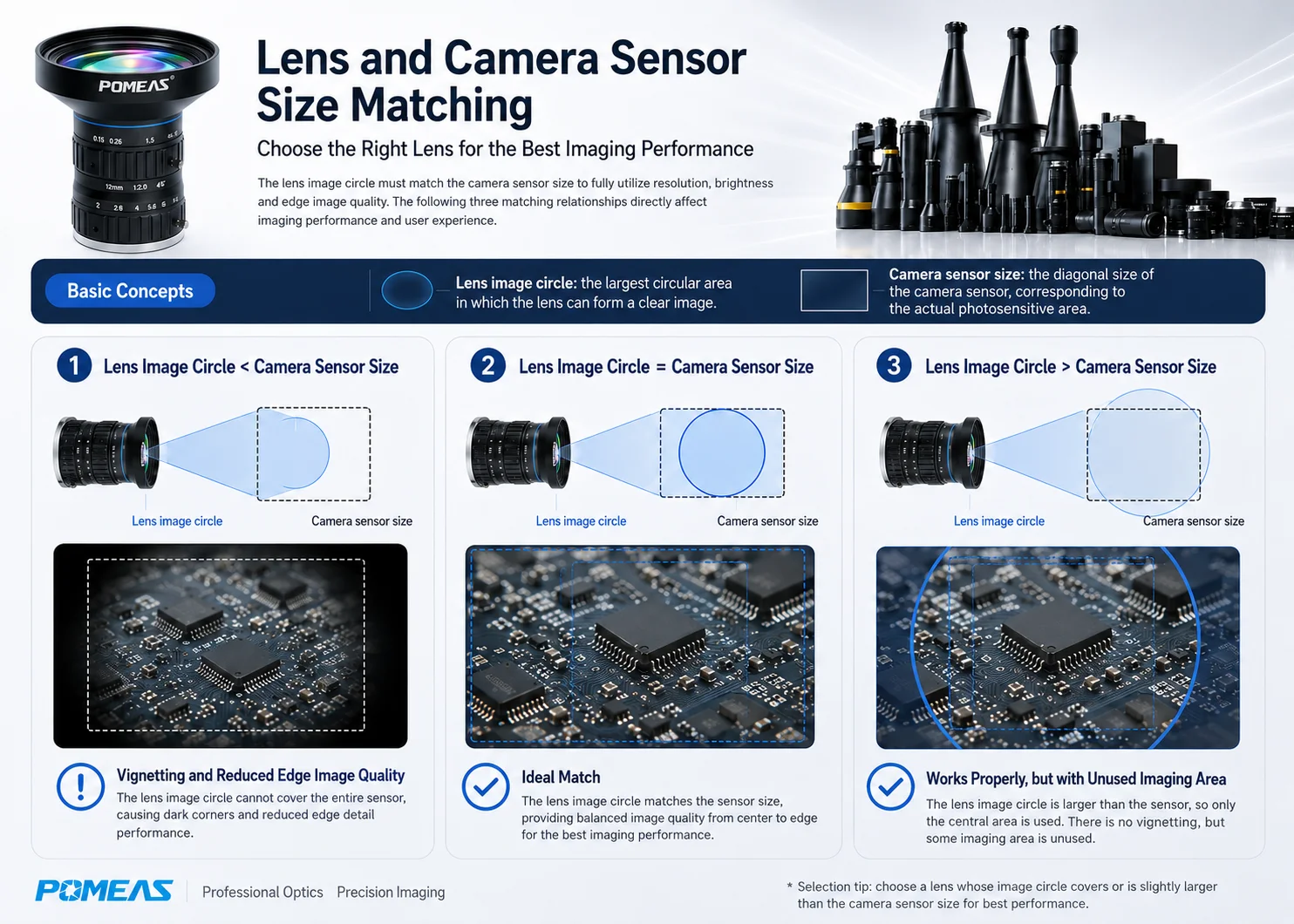
The first thing to check is simple: how large is the camera sensor, and can the lens image circle fully cover it?
If the supported lens format is smaller than the camera sensor size, the image may show vignetting, blurred edges, lower edge image quality or increased distortion near the edge. For example, if a customer uses a 1-inch industrial camera with a lens that only supports a 2/3-inch sensor, the center image may still look acceptable, but the edge area may become dark, soft or unstable.
On the other hand, if the lens supports a larger sensor size than the camera, it can usually be used normally. The camera simply does not use the full image circle of the lens, which means some imaging area is unused.
This usually does not affect normal use. In many cases, it may even help edge image stability, because the camera uses the central area of the lens where the image quality is usually better.
So, when selecting an FA industrial lens, the first question should not be focal length. We should first confirm the camera sensor size, the maximum sensor format supported by the lens, and whether the lens image circle can fully cover the camera sensor.
4. Relationship Between FOV, Working Distance and Focal Length
Field of view, or FOV, refers to the actual area that the camera needs to capture. For example, if the object size is 30 × 40 mm, the actual FOV is usually not set exactly to 30 × 40 mm. In real equipment, we often need extra margin for product placement tolerance, fixture positioning error, edge inspection area and software recognition background.
So the real FOV is usually slightly larger than the object size.
However, a larger FOV is not always better. When the FOV becomes larger, each pixel covers a larger real-world area, and image detail decreases. When the FOV becomes smaller, image detail improves, but the inspection area becomes smaller.
Working distance, or WD, means the distance from the front lens element to the object surface. This point is important because many customers mistakenly think that working distance means the distance from the camera body to the object. In lens selection, these are not the same.
In real equipment, working distance is often limited by camera mounting height, lens length, lighting space, object height, mechanical structure, protective cover, motion mechanism and maintenance space.
Sometimes a certain focal length may theoretically meet the FOV requirement. But after installation, the lighting cannot fit, the lens is too close to the object, or the mechanical structure interferes with the optical path. In that case, the theoretical solution cannot be used in the real machine.
So if a customer only says “I need a 25mm lens” but does not provide working distance, it is difficult to judge whether that lens is really suitable. A better selection process is: first confirm the required FOV, then confirm the camera sensor size, then check the available working distance in the machine, and finally estimate the proper focal length range.
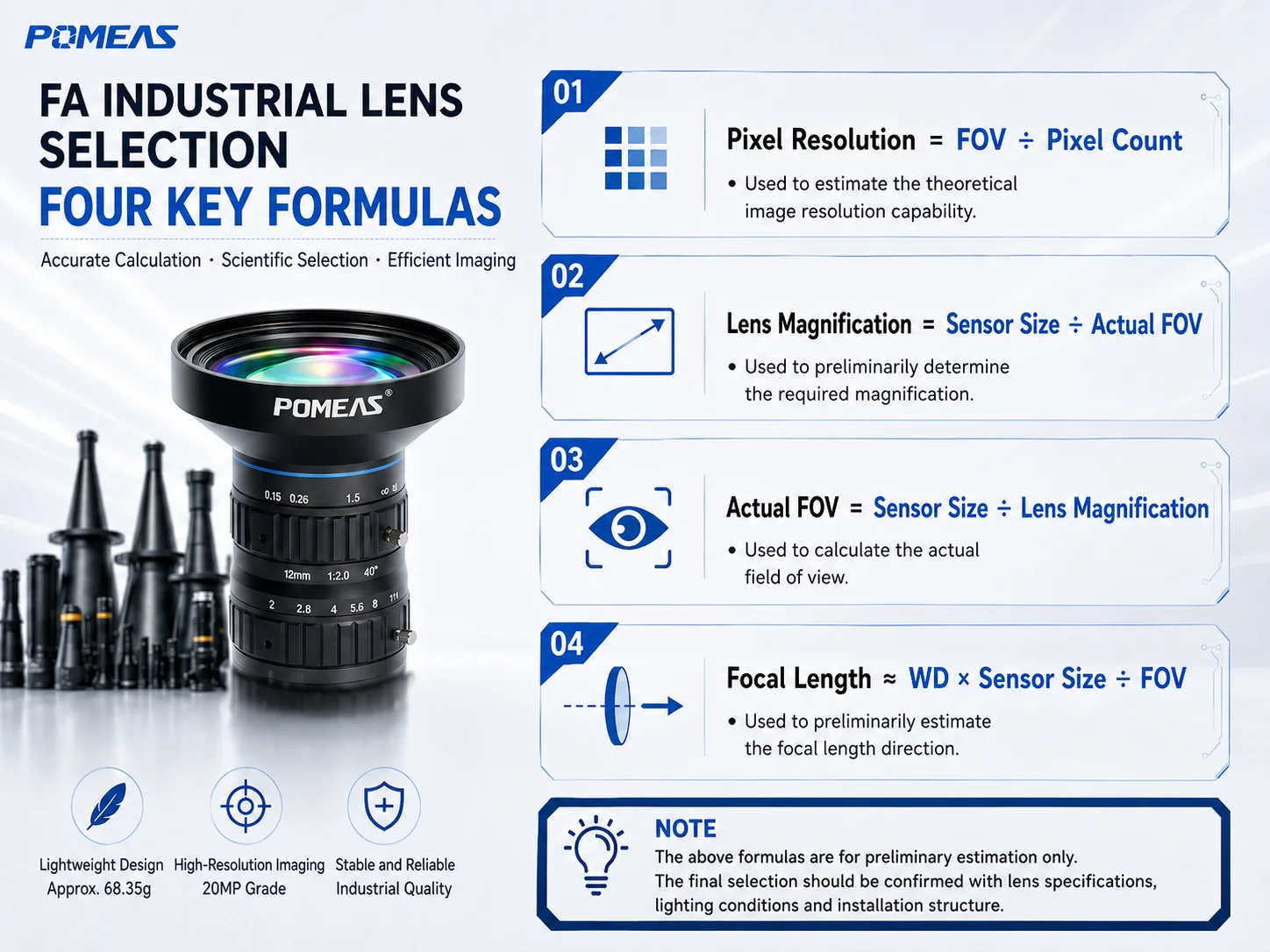
5. Common Machine Vision Calculation Formulas
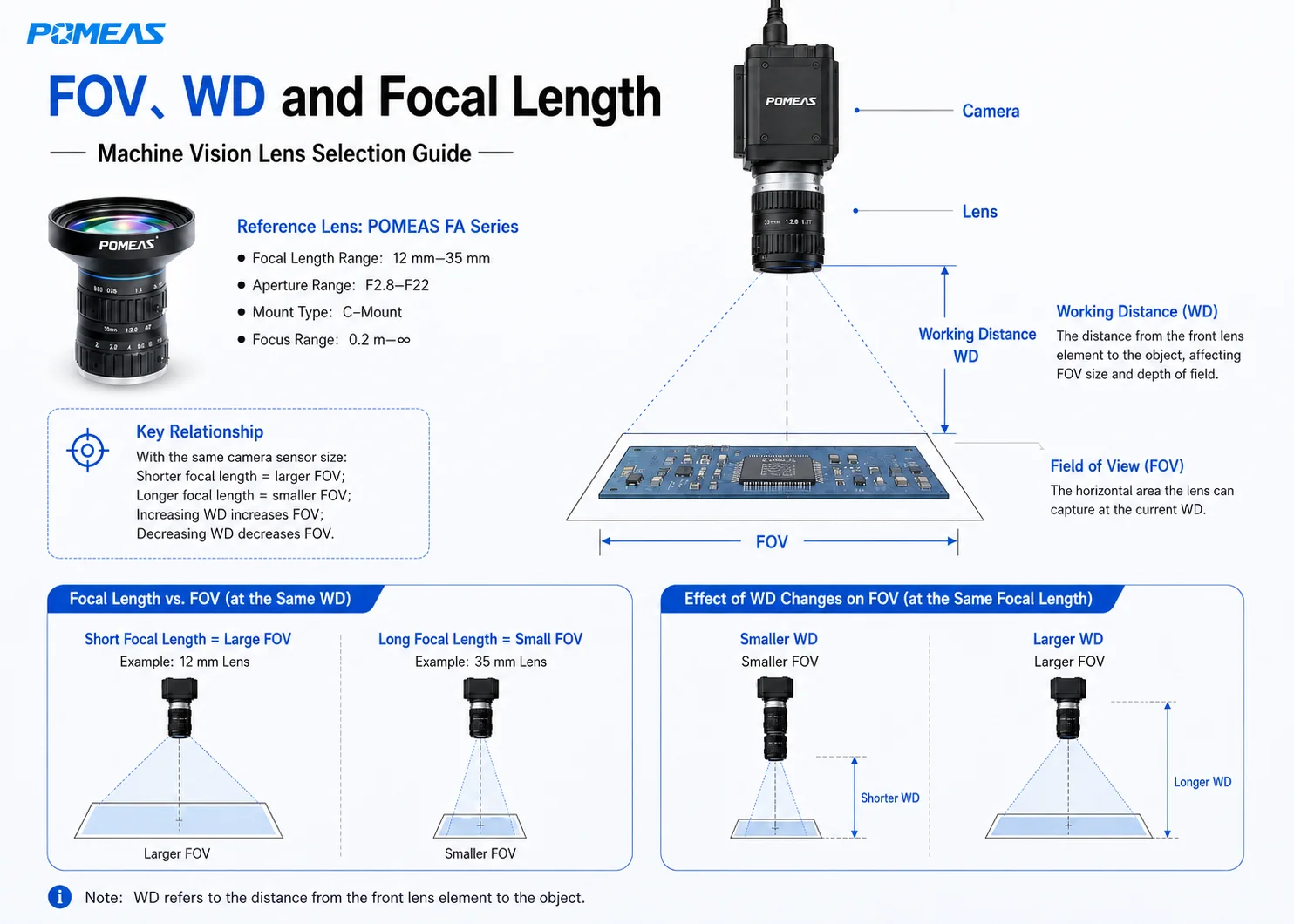
In FA industrial lens selection, several common formulas can help us make an initial judgment. These formulas are useful for early estimation, but the final selection should still be confirmed together with the real lens specifications, distortion, working distance, lighting and installation structure.
| Calculation Item | Common Formula | Purpose |
|---|---|---|
| Pixel Resolution | FOV ÷ Pixel Count | Estimate theoretical image resolution |
| Lens Magnification | Camera Sensor Size ÷ Actual FOV | Estimate the required magnification direction |
| Actual FOV | Camera Sensor Size ÷ Lens Magnification | Estimate the visible field when magnification is known |
| Focal Length Estimation | WD × Sensor Size ÷ FOV | Estimate the initial focal length direction |
For example, if the customer needs a 40 mm horizontal FOV and the camera has 4000 horizontal pixels, then the theoretical pixel resolution is about 0.01 mm per pixel, or 10 μm per pixel.
But this does not mean the system can definitely achieve 10 μm inspection accuracy. Real inspection accuracy is also affected by lens resolution, lens distortion, focus condition, lighting stability, edge contrast, calibration accuracy, mechanical vibration, object placement error and software algorithm.
So I usually do not tell customers directly: “Your theoretical pixel size is 10 μm, so your accuracy is 10 μm.” A more reasonable explanation is that theoretical pixel resolution is only the first step to judge whether a solution may meet the requirement. The real inspection accuracy depends on the stability of the entire imaging chain.
6. FA Industrial Lens Selection Steps
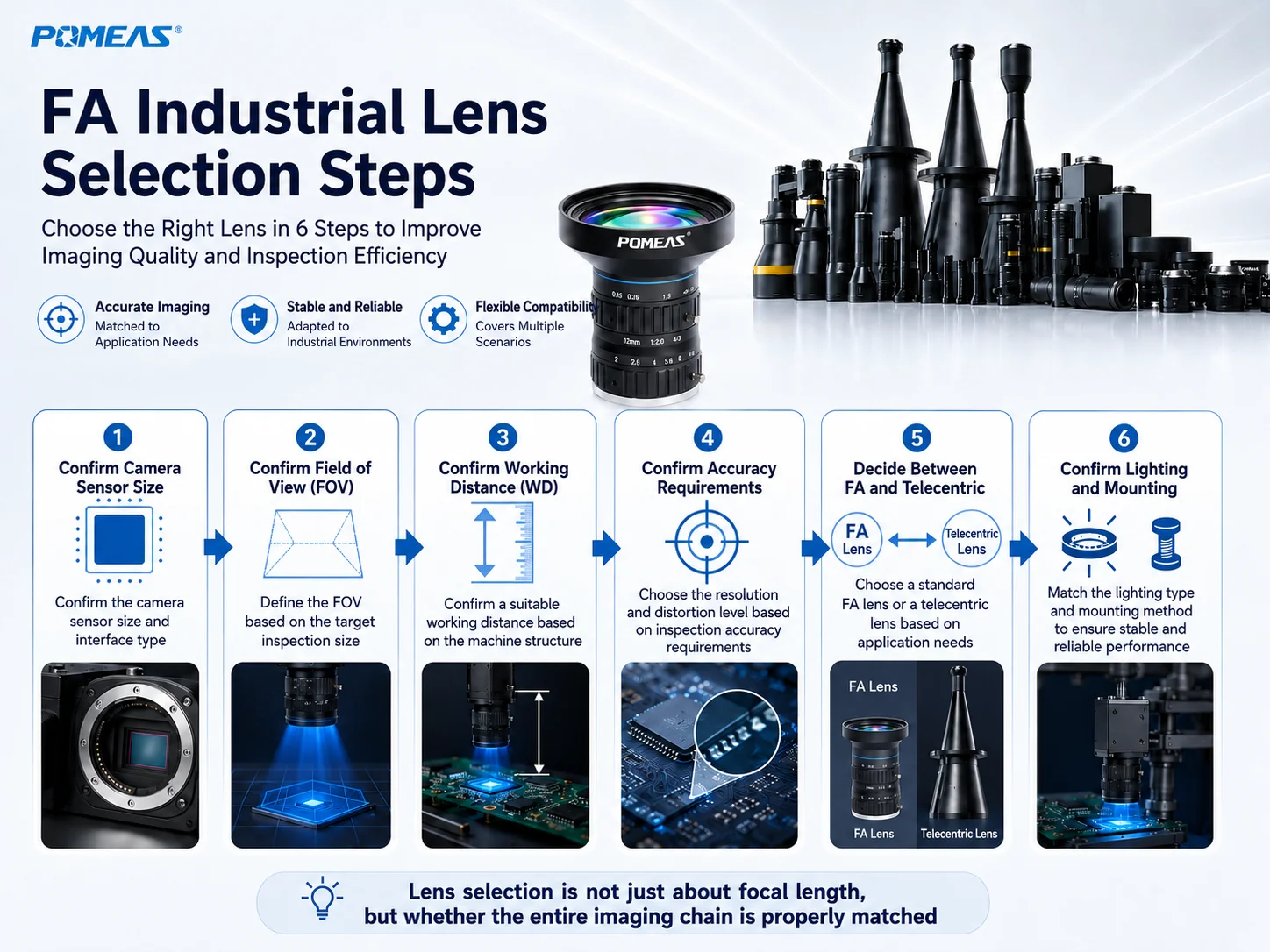
If we want to select an FA industrial lens more reliably, I usually follow the steps below.
Step 1: Confirm the Camera Sensor Size
First confirm the camera sensor size, resolution, pixel size and interface type. The lens must cover the camera sensor. Otherwise, vignetting or edge image quality loss may occur.
Step 2: Confirm the Required FOV
Define the actual field of view based on the object size and inspection area. The FOV should have some margin, but it should not be made too large without reason, because a larger FOV reduces image detail.
Step 3: Confirm the Working Distance
Check how much distance can be kept between the front lens element and the object surface. Lighting, mechanical structure and maintenance space should also be considered.
Step 4: Confirm the Inspection Accuracy Requirement
If the task is mainly recognition, positioning or appearance inspection, an FA lens is usually a good starting point. If the task requires high-precision dimensional measurement, distortion, calibration, lighting and mechanical stability must be evaluated more carefully.
Step 5: Decide Whether to Use an FA Lens or a Telecentric Lens
A standard FA lens is suitable for many imaging and inspection tasks. A telecentric lens is more suitable for high-precision measurement, low-distortion requirements and applications that require stable magnification.
Step 6: Confirm Lighting and Installation Method
In many vision projects, poor image quality is not always caused by the lens. It may also be caused by lighting. Metal, glass, black plastic and PCB solder joints all need to be evaluated together with the lighting method.
7. Common Selection Mistakes
Mistake 1: Selecting a Lens Only by Focal Length
Many customers directly ask for a 25mm or 50mm lens, but focal length is only the result, not the starting point. The real starting points should be camera sensor size, FOV, working distance and inspection accuracy.
Mistake 2: Ignoring Camera Sensor Size
If the supported lens format is smaller than the camera sensor size, vignetting and edge image quality loss may occur. This is especially important for 1-inch, 1.1-inch or other larger sensor cameras.
Mistake 3: Using a High-Resolution Camera with a Low-Resolution Lens
A high-resolution camera does not automatically produce a clear image. If the lens resolution is not sufficient, the camera cannot fully perform, and the final image may still look soft or unclear.
Mistake 4: Forcing an FA Lens to Do High-Precision Measurement
FA lenses can be used for general dimensional checking, but if the customer requires high accuracy, low distortion, stable magnification and high repeatability, a telecentric lens should be evaluated seriously.
Mistake 5: Ignoring Lighting and Object Surface
Metal reflection, glass transparency, low contrast on black plastic and PCB solder joint reflection are often not solved by changing the lens alone. They usually need to be handled together with proper machine vision lighting.
8. Typical Application Examples
FA industrial lenses can be used in many automated vision projects, including PCB inspection, metal part inspection, packaging and label inspection, barcode reading, robot positioning and general industrial inspection.
In PCB inspection, FA lenses can be used for component presence detection, orientation recognition, QR code reading and general appearance inspection. If high-precision pad measurement is required, a telecentric lens may need to be evaluated.
In metal part inspection, FA lenses can be used for edge detection, hole recognition, surface scratch inspection and contour inspection. Since metal surfaces are often reflective, coaxial light, ring light, bar light, dome light or polarized light may be needed to improve image stability.
In packaging and label inspection, FA lenses are suitable for label position inspection, barcode reading, OCR recognition and print quality checking. These applications usually have a fixed FOV and working distance, and the main lens requirements are clear image quality, stable edges and acceptable distortion.
9. When an FA Industrial Lens May Not Be the Best Choice
An FA industrial lens is not the best choice for every vision project. In the following cases, a standard FA lens should not be the only option considered:
- The application requires high-precision dimensional measurement.
- Object height variation affects measurement results.
- Stable magnification is required at different object heights.
- Very low distortion is required.
- The FOV is large, but the accuracy requirement is also high.
- The system needs frequent magnification adjustment.
- The object is very small and requires microscopic observation.
- The application requires very large depth of field.
For these cases, a telecentric lens, telecentric zoom lens, continuous zoom lens, microscope lens, measurement system or special lighting solution may be more suitable.
10. What Parameters Should Customers Send to POMEAS?
To help POMEAS recommend a suitable FA industrial lens more quickly, customers can provide the following information:
- Camera model
- Camera sensor size
- Camera resolution
- Pixel size
- Camera interface
- Object size
- Required field of view
- Working distance
- Inspection accuracy requirement
- Inspection purpose
- Object material and surface condition
- Existing lighting condition
- Installation space limitation
- On-site photos or sample images
If the parameters are not complete yet, customers can first provide the three most important ones: FOV, working distance and camera sensor size. With these three parameters, we can usually make an initial lens selection direction.
11. Related Products and Selection Support
If you are selecting an FA industrial lens, the following POMEAS product directions may also be useful:
- Machine Vision Lenses
- Industrial Camera Lenses
- Telecentric Lenses
- Machine Vision Lighting
- About POMEAS
- Contact POMEAS for Lens Selection Support
If you are not sure whether your project should use an FA lens, telecentric lens or zoom lens, you can send your camera parameters, FOV, working distance, accuracy requirement and sample images to POMEAS. We can help evaluate the proper optical direction based on real application conditions.
12. FAQ: Common Questions About FA Industrial Lenses
Q1: What is an FA industrial lens?
An FA industrial lens is a lens used in factory automation vision systems. It is commonly used with industrial cameras for inspection, positioning, recognition, measurement and image acquisition.
Q2: What is the difference between an FA lens and a CCTV lens?
An FA lens is designed more for industrial vision applications. It usually offers better resolution, distortion control, mechanical stability, sensor matching and industrial application reliability than ordinary CCTV lenses.
Q3: Can an FA lens be used for dimensional measurement?
Yes, but it depends on the accuracy requirement. For general dimensional checking, an FA lens can be used. For high-precision measurement requiring low distortion, stable magnification and high repeatability, a telecentric lens should be evaluated.
Q4: Why does a high-resolution camera still produce unclear images?
Possible reasons include insufficient lens resolution, incorrect focus, unsuitable working distance, improper aperture setting, insufficient depth of field, unstable lighting, strong object reflection, or mismatch between lens image circle and camera sensor size.
Q5: How do I choose an FA lens based on FOV?
You need to confirm the camera sensor size, target FOV and working distance first. In general, a larger FOV requires a shorter focal length, while a smaller FOV can use a longer focal length. The final choice also depends on sensor support, distortion and lens resolution.
Q6: Can a 1-inch camera use a standard C-mount FA lens?
Yes, but only if the FA lens supports a 1-inch sensor format. C-mount only refers to the mechanical interface. It does not mean the lens can cover a 1-inch camera sensor. If the lens only supports 2/3 inch, vignetting or edge image quality loss may occur.
Q7: How should I choose between an FA lens and a telecentric lens?
If the project is mainly for recognition, positioning or appearance inspection, an FA lens is usually more economical and practical. If the project focuses on high-precision dimensional measurement, low distortion, stable magnification and reduced error from object height variation, a telecentric lens is more suitable.
How do I confirm the working distance when selecting an FA industrial lens?
Working distance is the distance from the front lens element to the object surface. In real equipment it is often limited by camera mounting height, lens length, lighting space, object height and mechanical structure. Confirm the available distance before choosing a focal length, because a lens that meets the FOV requirement on paper may not fit once lighting and mechanics are installed.
What are the most common mistakes when selecting an FA industrial lens?
Common mistakes include selecting a lens only by focal length, ignoring the camera sensor size (which can cause vignetting and edge image quality loss), pairing a high-resolution camera with a low-resolution lens, forcing an FA lens into high-precision measurement work, and ignoring lighting and object surface characteristics.
When is an FA industrial lens not the best choice?
An FA lens should not be the only option considered when the project requires high-precision measurement, low distortion, stable magnification, or repeatable results across the field of view. In those cases a telecentric lens, telecentric zoom lens, continuous zoom lens, microscope lens or a dedicated measurement system is usually more suitable.
Further reading: the test methods behind this article are documented in POMEAS Technical Reference how to measure FOV, working distance and magnification (§§8.1 FOV) + #s32).
Related reading
- What is a motorized zoom lens? — when magnification has to be recalled from a recipe instead of set by hand.
- Motorized zoom lens applications — the applications that justify a motorized zoom axis.

Subscribe to Our Newsletter
Simply enter your email to receive the latest news and insights from Pomeas. Stay connected with Pomeas and be the first to discover new innovations in optical excellence.