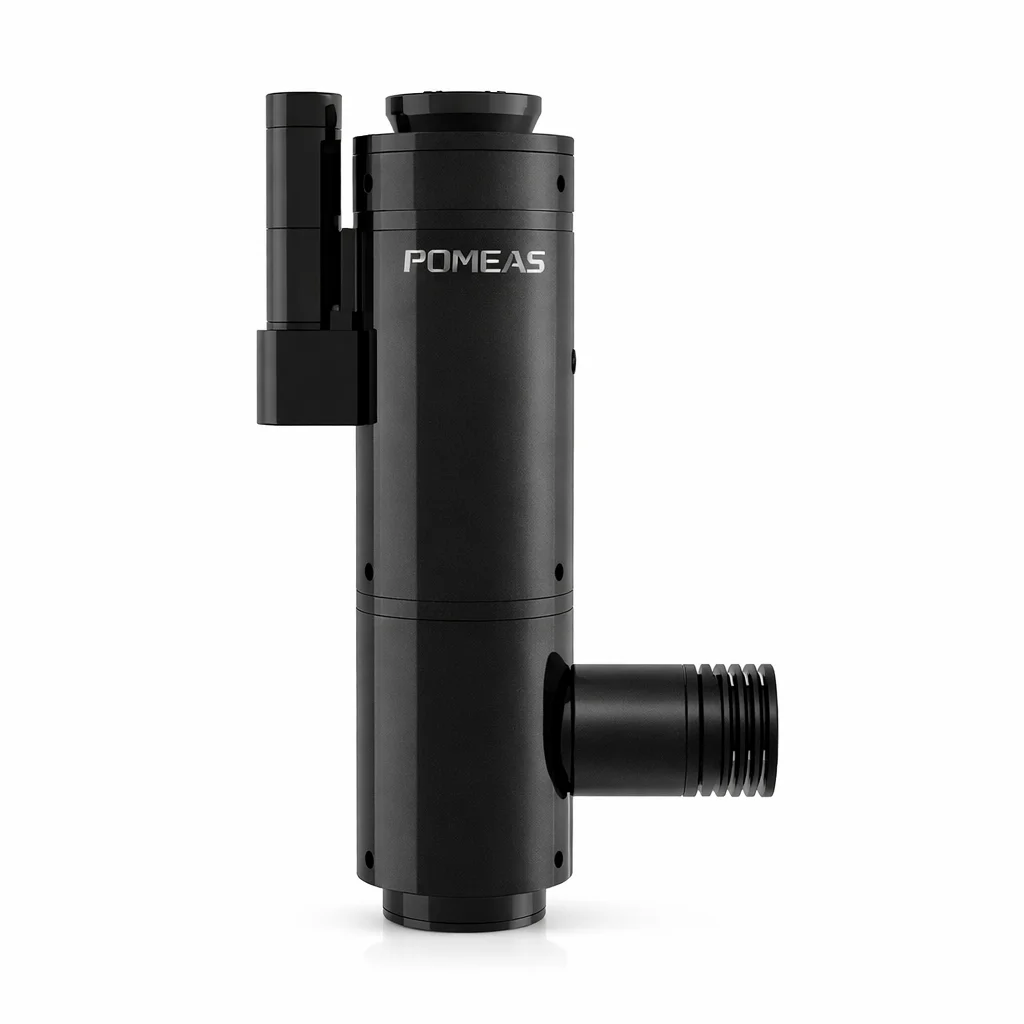
What Is a Motorized Zoom Lens?
A motorized zoom lens is a machine vision lens whose magnification and focus are moved by motors instead of by hand. In a manual zoom lens an operator turns two rings; in a motorized lens those same two axes are driven by stepper or DC servo motors, usually under closed-loop control, so the optical setting becomes a programmable parameter of the inspection recipe.
The three axes that matter
Understanding the category is easier if you separate what actually moves inside the lens:
- Zoom axis — changes optical magnification, and therefore the field of view, without changing the camera.
- Focus axis — keeps the image sharp when magnification changes (parfocality) or when the working distance changes.
- Optional iris / illumination axis — adjusts the aperture or the integrated coaxial illumination for reflective surfaces.
Zoom and focus are separate axes. A lens that only moves the zoom group but keeps the focus ring manual is usually called a zoom lens with motorized zoom; when both axes are motorized and controlled in a closed loop, magnification positions can be recalled automatically per product recipe.
How the control side works
Motorized zoom lenses for industrial use are normally commanded over RS-232 or an industrial bus. The lens carries its motors and, on the more advanced models, encoder feedback, so the controller can both command and verify a position. The practical consequence is that a PLC, a PC or a vision application can store a magnification value alongside the product recipe and recall it at changeover — the same physical station then inspects parts of different sizes without a lens swap.
The control interface, the number of axes and the presence of position feedback are the three specifications that decide how much automation a given lens can support. They are documented in the datasheet of each lens, not inferred from the zoom ratio.
Motorized zoom vs manual zoom vs fixed focal length
| Question | Fixed focal length / fixed magnification | Manual zoom | Motorized zoom |
|---|---|---|---|
| Field of view changes between products? | No — a different lens or a different stand-over distance is needed | Yes, but an operator must turn the rings each time | Yes, and the position can be recalled from the recipe |
| Repeatability of the magnification setting | Fixed by the lens | Depends on the operator | Defined by the motor, the gearing and the feedback |
| Calibration cost | Lowest | Must be re-checked after every manual change | One-time calibration, then reusable positions |
| Best fit | One product, highest accuracy requirement | Low volume, frequent but non-automated changes | Multiple products, automated lines, closed-loop stations |
If the field of view never changes, a fixed-magnification telecentric lens gives the simplest calibration and the lowest distortion. A motorized zoom lens earns its place when one station must handle several product sizes or must zoom in on different features of the same part. This trade-off is also discussed in the FA industrial lens selection guide and the programmable optics overview.
Where the parameter that changes is not magnification
On some lines the parameter that has to change between products is not the magnification but the working distance, or the light. A motorized zoom lens solves the first only if the focus axis is also motorized and precisely calibrated; illumination is handled by the lens only when it integrates a motorized or switchable coaxial light path. Check the datasheet before assuming a zoom lens covers all three.
Practical selection checklist
- Smallest feature or defect to detect, in the unit the inspection actually measures (mm or µm).
- Required field of view — the largest and the smallest one, not just the nominal.
- Camera sensor size and pixel size, because magnification, not the lens alone, sets the resolution on the object.
- Working distance and the mechanical space available around the station.
- Number of product recipes per shift, i.e. how often the magnification must change.
- Whether the magnification position must be recorded and verified (audit trail), which requires feedback.
- Lighting: reflective, transparent, or with height differences across the part.
For a worked example of this reasoning on a real inspection task, see the zoom lens selection case: 10–4 mm FOV and 5 µm defect inspection.
Related POMEAS products
- LZ-650104 — 6.5X motorized zoom lens: 0.7X–4.5X optical magnification, 82 ± 2 mm working distance, C-mount, 2/3-inch sensor, RS-232 closed-loop control.
- PMS-LZL-12105 — 12.5X motorized coaxial zoom lens: 0.58X–7.5X magnification with a telecentric optical path and integrated coaxial illumination.
How the performance of such a lens is verified
A motorized zoom lens is only as repeatable as its parfocality and its position repeatability. The test procedures for field of view, working distance, magnification, parfocality, repeatability and hysteresis are documented in POMEAS Technical Reference TR-001 — Machine Vision Optical Imaging Systems: Performance Test Methods. The adjustment procedure itself is described in the parfocality and centering adjustment procedure.
Need help selecting?
Send POMEAS your camera model, required field of view, working distance and the smallest feature to detect. Our engineers will evaluate the suitable magnification range and optical configuration. Request lens selection support.
Real integration example: Motorized zoom lens equipment integration: WD, mechanical length and parfocality verified - a documented automation case, not a product spec sheet.
Companion case: LZ-650104 selection & integration case: WD 163mm module, RS232 control, pulse map