Porduct Details
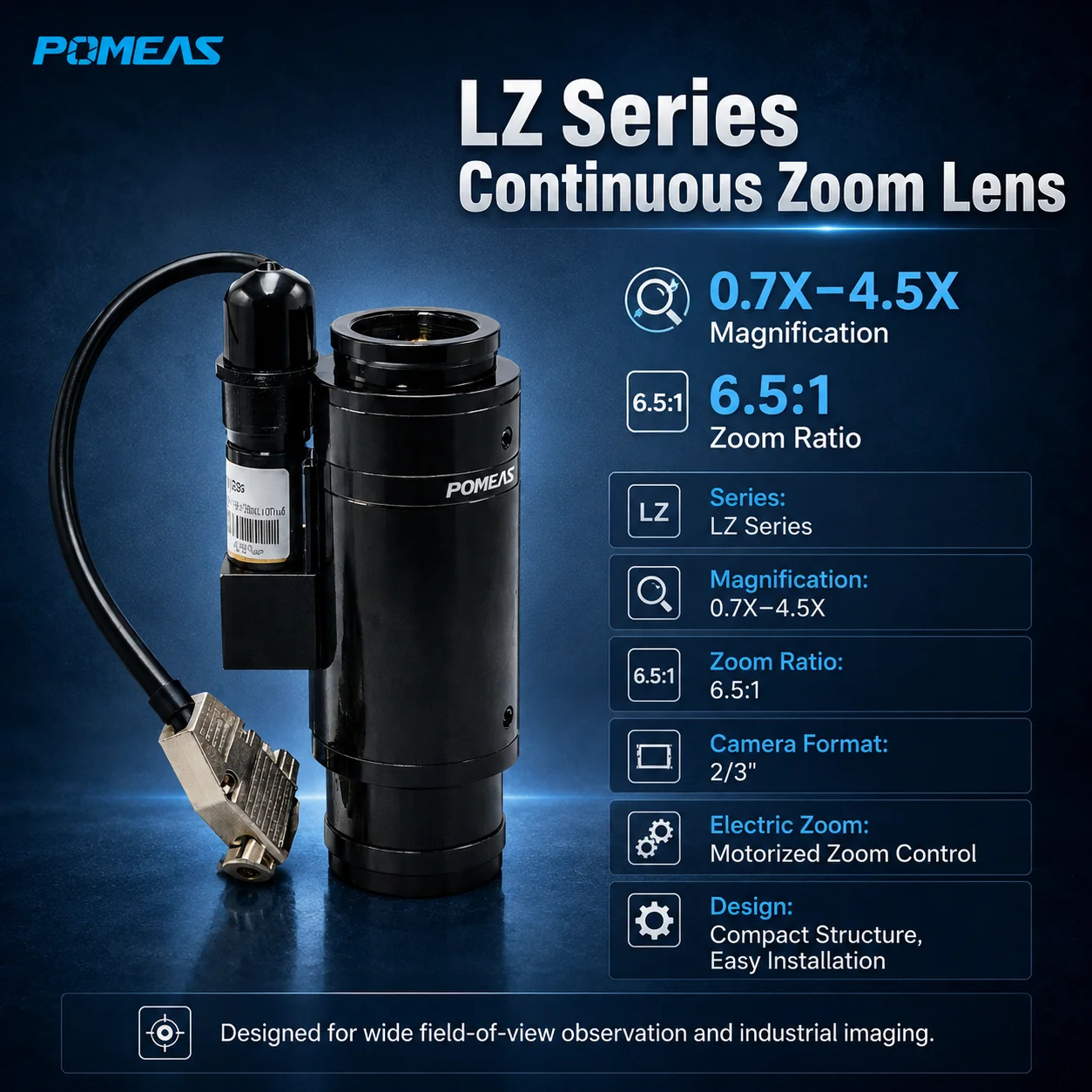
6.5X Motorized Zoom Lens | LZ-650104
6.5X motorized zoom lens LZ-650104 with 0.7X-4.5X magnification, 82±2 mm WD, C-mount, 2/3-inch sensor and closed-loop RS-232 motor control for automated inspection.
SKU:
LZ-650104 6.5X Motorized Zoom Lens
The POMEAS LZ-650104 is a 6.5X motorized zoom lens for machine vision inspection. It covers 0.7X–4.5X optical magnification (6.5:1 zoom ratio) on cameras up to a 2/3-inch sensor with a C-mount, and holds an 82 ± 2 mm working distance across the zoom range. Zoom and focus are driven by imported DC servo motors with closed-loop control for high-speed, high-repeatability positioning, which makes the lens suitable for semiconductor inspection, industrial automation and electronic communication applications.
Key Specifications
| Parameter | Specification |
|---|---|
| Model | LZ-650104 |
| Category | Motorized Zoom Lens |
| Zoom Ratio | 6.5:1 |
| Optical Magnification | 0.7X-4.5X |
| Working Distance | 82 ± 2 mm |
| Max. Sensor Size | 2/3 Inch |
| Mount | C-Mount |
| Zoom Mode | Motorized (closed-loop DC servo) |
| Control Interface | 9-pin RS-232, single/dual-axis |
| Resolution | 1.18 μm (0.7X) – 3.95 μm (3.0X-4.5X) |
| Depth of Field | 1.9 mm (0.7X) – 0.1 mm (4.5X) |
| N.A. | 0.03 – 0.085 |
| F/No. | 11.6 – 26.5 |
| TV Distortion | 0.001% – 0.035% across 0.7X–4.5X (min 0.001% at 3.0X/3.5X, max 0.035% at 1.0X, 0.019% at the 0.7X wide end) |
Optical Performance by Magnification (LZ-650104 Datasheet)
Optical performance is specified per magnification rather than as a single worst-case figure. The table below is transcribed from the POMEAS LZ-650104 datasheet and applies at the nominal 82 ± 2 mm working distance with a 2/3-inch sensor and the standard C-mount configuration, with no auxiliary objective, TV tube adapter or relay optic between lens and camera.
| Magnification | TV Distortion | Resolution (μm) | Depth of Field (mm) | N.A. | F/No. |
|---|---|---|---|---|---|
| 0.7X | 0.019% | 1.18 | 1.9 | 0.03 | 11.6 |
| 1.0X | 0.035% | 7.9 | 0.952 | 0.042 | 12.1 |
| 1.5X | 0.002% | 5.59 | 0.44 | 0.06 | 12.5 |
| 2.0X | 0.003% | 4.79 | 0.29 | 0.07 | 14.2 |
| 2.5X | 0.004% | 4.79 | 0.23 | 0.07 | 17.8 |
| 3.0X | 0.001% | 3.95 | 0.16 | 0.085 | 17.6 |
| 3.5X | 0.001% | 3.95 | 0.13 | 0.085 | 20.5 |
| 4.0X | 0.002% | 3.95 | 0.12 | 0.085 | 23.5 |
| 4.5X | 0.002% | 3.95 | 0.10 | 0.085 | 26.5 |
Source and datasheet edition note. Source: POMEAS LZ-650104 datasheet. The Chinese and English datasheet editions agree at every magnification except the 1.0X resolution, where the Chinese edition prints 7.9 μm and the English edition prints 7.99 μm. The table above uses the Chinese datasheet value. The difference is a rounding and edition difference between the two printings, not two independent measurement results, so the figures should not be presented as separate measured data.
How to read the distortion row. TV distortion does not fall monotonically across the zoom range: it is 0.019% at the 0.7X wide end, peaks at 0.035% at 1.0X and reaches 0.001% at 3.0X and 3.5X. Quote the value for the magnification actually used in the inspection recipe. For the corresponding object-side field of view at each step see Field of View on a 2/3-Inch Sensor.
Field of View on a 2/3-Inch Sensor
Object-side field of view at the working plane = the 2/3-inch sensor dimension ÷ optical magnification (2/3-inch format: 11.0 mm diagonal, 8.8 × 6.6 mm active area). These are object-side fields measured at the inspection plane, not sensor dimensions. Datasheet values for the LZ-650104 (D × H × V, mm):
| Magnification | FOV (D × H × V, mm) |
|---|---|
| 0.7X | 15.71 × 12.57 × 9.43 |
| 1.0X | 11.00 × 8.80 × 6.60 |
| 1.5X | 7.33 × 5.87 × 4.40 |
| 2.0X | 5.50 × 4.40 × 3.30 |
| 2.5X | 4.40 × 3.52 × 2.64 |
| 3.0X | 3.67 × 2.93 × 2.20 |
| 3.5X | 3.14 × 2.51 × 1.89 |
| 4.0X | 2.75 × 2.20 × 1.65 |
| 4.5X | 2.44 × 1.96 × 1.47 |
Need Help Selecting the Right Configuration?
Send POMEAS your camera model or sensor size, required field of view, working distance, the smallest feature or defect to detect and the inspection object. Our engineers will evaluate the suitable magnification and optical configuration for your application.
Related Optical Solutions
Explore more POMEAS machine vision zoom lenses for different magnification ranges, motorized control options and illumination configurations.
Learn how to select a suitable zoom lens for PCB, semiconductor and precision inspection applications in the zoom lens selection case: 10-4 mm FOV, 5 μm defect inspection.
For reflective surfaces that require integrated coaxial illumination, view the LZ-650105 6.5X motorized coaxial zoom lens .
For lens and camera selection assistance, contact POMEAS with your required field of view, working distance, camera sensor size, smallest inspection feature and required inspection accuracy.
Related Reading
- Programmable Optics for Machine Vision: Capabilities
- Motorized Zoom Lens RS-232 Protocol: 5 Commands Explained
- Zoom Lens Parfocality and Centering: Adjustment SOP
- Zoom Lens Pulse Position: Magnification Mapping Explained
- PMSOpticDll SDK V4.4.7: Motorized Lens Control API
- Motorized Zoom Lens Troubleshooting: 4 Fault Classes
- Liquid Lens vs Motorized Autofocus FAQ
- Multi-SKU Changeover With One Camera FAQ
- Zoom Lens Selection Case: 10-4 mm FOV, 5 μm Defects
- FA Industrial Lens Selection Guide: Sensor Size, FOV, WD and Accuracy
- How to Choose a Telecentric Lens: FOV, WD, DOF & Accuracy
- Programmable Optics for AI Vision: Adaptive FOV, Motorized Zoom and Autofocus
- How to Integrate a Motorized Zoom Lens into AI Vision Equipment
- Case Study: Motorized Zoom Module Fold-Mirror Integration
- From Microscope to Machine Vision: Camera, Zoom Lens and Magnification Selection
- Microscope 400X vs Machine Vision Magnification: How Do You Convert It?
Related Products
Frequently Asked Questions
How do I calculate the field of view with the LZ-650104 motorized zoom lens?
Field of view = sensor dimensions ÷ optical magnification. Per the LZ-650104 datasheet on a 2/3-inch sensor: 15.71 × 12.57 × 9.43 mm (D×H×V) at 0.7X, 11.00 × 8.80 × 6.60 mm at 1.0X, and 2.44 × 1.96 × 1.47 mm at 4.5X. On 1/2-inch or 1/3-inch sensors these fields scale down proportionally to the sensor diagonal.
Can one LZ-650104 inspect different product sizes on the same line?
Yes. The 0.7X–4.5X (6.5:1) zoom range is driven by a closed-loop DC servo motor, so a PLC or PC can recall a magnification position for each product recipe and the field of view changes accordingly — no lens swap or manual refit between SKUs. See the multi-SKU changeover FAQ for the recipe workflow.
Does the image stay in focus across the zoom range?
Zoom and focus are separate motorized axes with closed-loop control. After a one-time parfocality calibration the image stays in focus across the 0.7X–4.5X range; the calibration and centering procedure is documented in POMEAS's parfocality adjustment SOP.
How do I integrate the LZ-650104 with a PLC or PC?
The lens is controlled through a 9-pin RS-232 interface with single- or dual-axis closed-loop control; the connector carries motor winding and encoder feedback signals. POMEAS supplies the RS-232 command set and low-level software code for OEM platforms — see the RS-232 protocol and SDK integration guides.
When should I choose the 6.5X LZ-650104 instead of the 12.5X LZL-12105?
Use the 6.5X when the part is larger: on a 2/3-inch sensor it covers up to 15.71 × 12.57 mm at 0.7X. Use the 12.5X (0.58X–7.5X) when the smallest feature needs more than 4.5X magnification or a field of view below about 2.4 mm. If the inspection also needs a telecentric path with coaxial illumination, compare the LZ-650105 coaxial version and the LZL-12105.

Subscribe to Our Newsletter
Simply enter your email to receive the latest news and insights from Pomeas. Stay connected with Pomeas and be the first to discover new innovations in optical excellence.



1 Files