Knowledge
Zoom vs Magnification: What Is the Difference and Which Industrial Lens Do You Need?
Quick answer: zoom and magnification describe two different optical changes, and mixing them up leads to the wrong lens purchase. Zoom means changing the focal length of the optical system, which changes the field of view. Magnification is the ratio between image size and object size; changing it changes how large the part appears on the sensor. In factory automation, "changing the focal length" is most often done by selecting a different fixed-focal FA lens from a focal-length range, while "changing the magnification inside one lens" is exactly what an industrial zoom lens is built for. This article explains both terms, shows how they are related by one simple formula, and helps you decide which lens type your project actually needs.
1. What Is Zoom? (Changing the Focal Length)
Focal length is a property of the lens itself: the distance (in air, at infinite focus) between the optical principal plane and the focal point, measured in millimetres. When you "zoom", you change this focal length. The direct optical consequence is a change of field of view (FOV):
- Longer focal length → narrower field of view, the object appears larger on the sensor.
- Shorter focal length → wider field of view, more of the scene fits on the sensor.
In machine vision practice, there are two very different ways to "zoom":
- Swap or select a fixed-focal lens. A fixed-focal FA industrial lens has one focal length that cannot be changed — 8 mm, 12 mm, 16 mm, 25 mm, 35 mm, 50 mm, 75 mm and so on. Changing the field of view means mounting a different lens. This is the most common approach on production lines because a fixed focal length gives simple optics, low distortion, predictable image quality and low cost.
- Use a lens with an adjustable focal length (varifocal). Such a lens changes focal length by moving internal lens groups. The catch: in a varifocal design the focal plane shifts while you adjust, so the image goes out of focus and must be re-focused after every change. For precision inspection this refocusing penalty is usually unacceptable.
A true industrial zoom lens avoids that penalty by being parfocal: the image stays in focus across the whole adjustment range. That requirement — parfocality with stable centering — is what separates a serious factory-automation zoom lens from a generic varifocal barrel lens.

A fixed-focal FA lens offers one focal length per model (here 25 mm). Field-of-view changes are made by selecting a different focal length.
2. What Is Magnification? (Changing the Image Ratio)
Magnification is not a property of the lens alone — it describes the relationship between the object and its image:
magnification = image size ÷ object size
For a given sensor, magnification and field of view are two sides of the same coin. The one formula worth remembering:
FOV = sensor size ÷ magnification
A zoom lens changes magnification continuously inside one barrel by moving internal lens groups. For example, a 6.5X zoom lens covers 0.7X–4.5X optical magnification: at 0.7X a 2/3-inch sensor sees a 15.71 mm diagonal field, and at 4.5X the same sensor sees 2.44 mm — an 6.5:1 zoom ratio, all without touching or re-focusing the lens if it is parfocal.
Two terms are often confused here:
- Zoom ratio (e.g. 6.5:1, 12.5X) is the ratio between the largest and smallest magnification of the lens — not a statement that the lens delivers "6.5X magnification".
- Magnification (e.g. 0.7X, 2.0X, 4.5X) is the actual image-to-object ratio at a given setting, and it is what you use to calculate FOV.
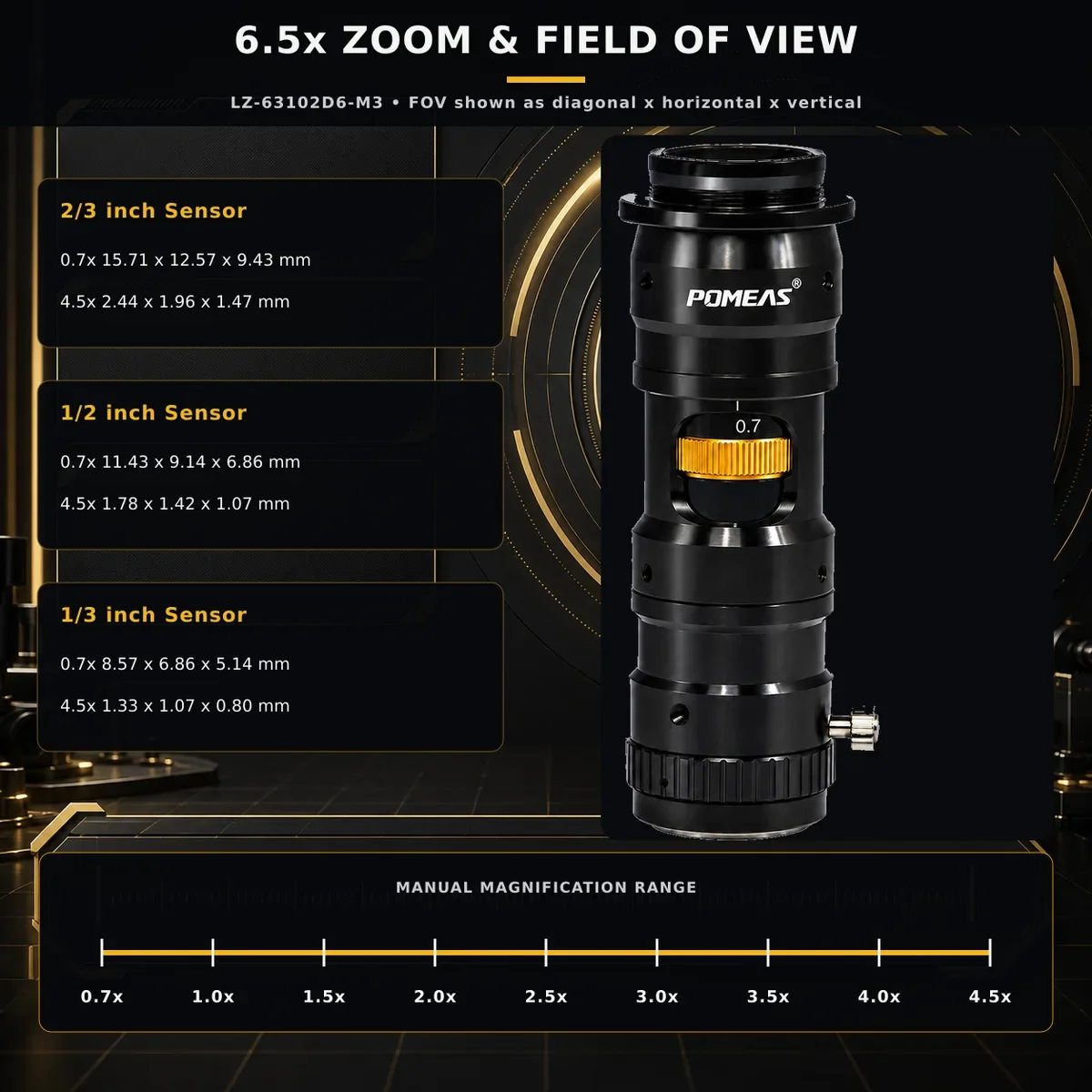
One lens, continuously variable magnification from 0.7X to 4.5X. The field of view scales with 1/magnification and also depends on the sensor size (official POMEAS datasheet values for a 6.5X manual zoom lens).
3. Zoom vs Magnification: Side-by-Side Comparison
| Zoom (focal-length change) | Magnification change | |
|---|---|---|
| What changes | Focal length of the optical system (mm) | Image-to-object size ratio (X) |
| Direct effect | Angle/size of the field of view | How large the part appears on the sensor (FOV = sensor ÷ magnification) |
| Typical implementation | Select/swap fixed-focal FA lenses (8 mm – 80 mm range) or a varifocal barrel | Continuous zoom lens, manual or motorized (0.58X–7.5X class) |
| Focus behaviour | Varifocal designs lose focus while adjusting; fixed lenses never change | Industrial zoom lenses are parfocal — focus holds across the range |
| Calibration | Per focal length / per lens change | Repeatable positions can be calibrated once and recalled |
| Best for | Fixed-FOV mass production, lowest cost per station | Mixed-SKU lines, R&D, one station covering many fields of view |
4. Optical Zoom vs Digital Zoom: Do Not Confuse Them Either
A third term adds to the confusion. Digital zoom is not optics at all — it is software cropping and upscaling the image from the sensor. Digital zoom makes the object look bigger on screen but does not add any new detail: the effective resolution per millimetre of the object gets worse with every click. Optical zoom / optical magnification change is done by real lens groups, so the sensor keeps sampling the object at its full native resolution.
When you compare lens datasheets, only the optical magnification range matters for inspection capability. If a system quotes a large "zoom" number achieved after cropping, the object-side resolution you actually get may be far worse than the number suggests.
5. Which Lens Type Fits Your Project?
Choose a fixed-focal FA lens when
- The field of view is fixed and known at design time.
- You run one product (or few products) in large volume and want the lowest cost per station.
- You need very low distortion or tight control of image geometry — fixed optics are simpler and more stable.
- Changing the FOV occasionally is acceptable because it only means mounting a different lens.
Browse the FA lenses category to see how focal length, sensor size and pixel count map to specific models.
Choose an industrial zoom lens when
- One camera must cover several fields of view — mixed-SKU changeovers, different part sizes on the same station.
- The project is in R&D or pilot phase and the final FOV is not frozen yet; a zoom lens removes the cost of re-buying lenses.
- You want remote or automated magnification control: motorized zoom lenses accept serial commands and can recall calibrated positions.
- Inspection needs a wide search and then a close look at a defect — zoom out to locate, zoom in to measure.
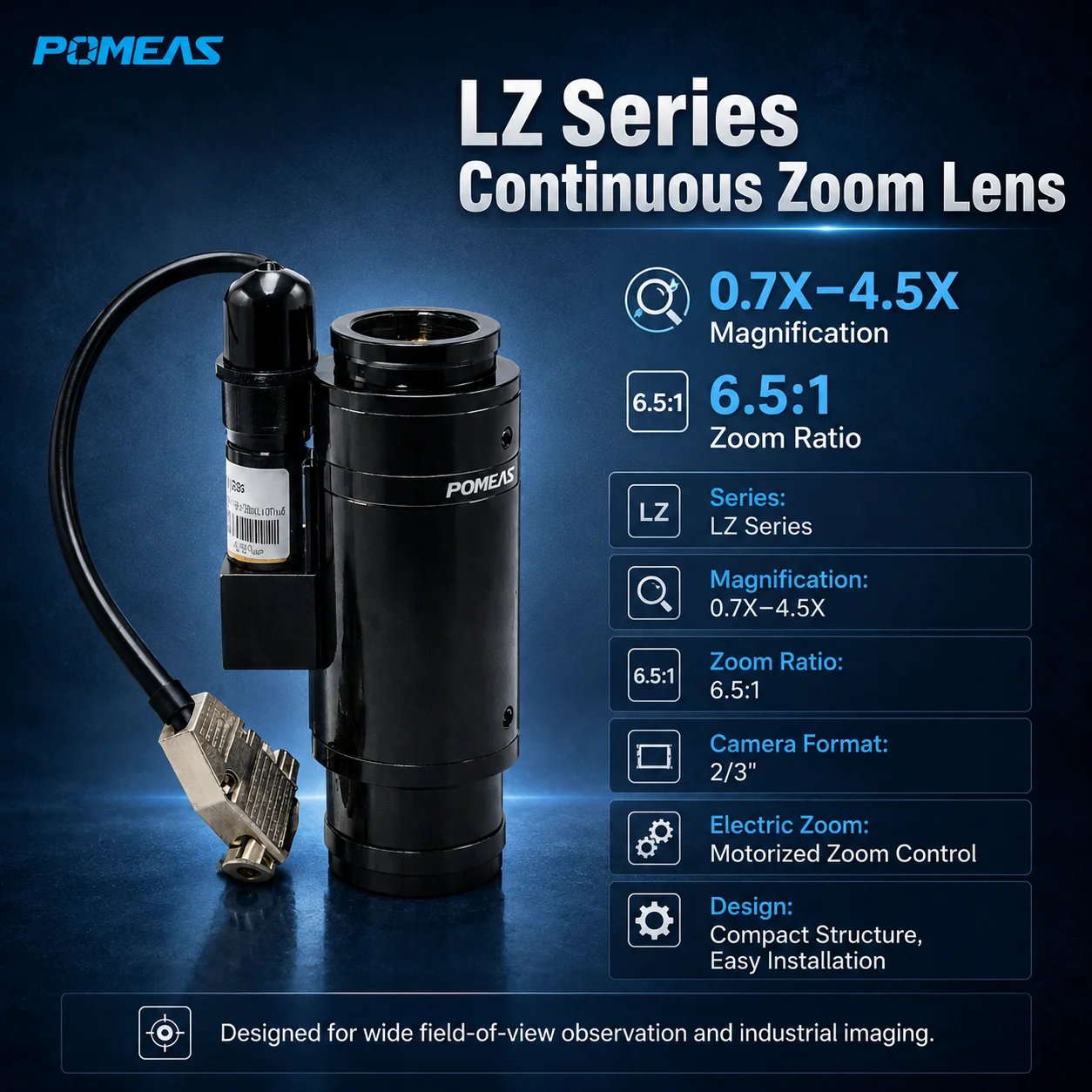
A motorized zoom lens (here the LZ-650104, 0.7X–4.5X) changes magnification inside one barrel — no lens swap, no re-focus, and positions can be recalled automatically.
The zoom lenses category lists manual, detented, coaxial and motorized models with their magnification ranges.
6. Common Mistakes to Avoid
- Reading "6.5X" as the magnification. In a 6.5X zoom lens the number is the zoom ratio (4.5X ÷ 0.7X ≈ 6.5). The actual magnification range is 0.7X–4.5X, and FOV must be calculated from those values.
- Ignoring the sensor size. The same magnification gives different fields of view on a 2/3-inch and a 1/3-inch sensor. Always calculate FOV = sensor size ÷ magnification for your camera.
- Accepting digital zoom as zoom. Cropped images lose object-side resolution; specify optical magnification change instead.
- Buying a varifocal lens for precision inspection. If the focus plane shifts every time you adjust, the station loses time and repeatability. Insist on parfocal behaviour with verified centering.
7. Frequently Asked Questions
Is zoom the same as magnification?
No. Zoom refers to changing the focal length of the optical system, which changes the field of view. Magnification is the ratio between image size and object size. A zoom adjustment changes magnification as a side effect, but they are different quantities and datasheets specify them differently.
What does a "6.5X zoom lens" actually mean?
The 6.5X is the zoom ratio — the ratio between the highest and lowest magnification, for example 4.5X divided by 0.7X. The lens itself covers 0.7X–4.5X optical magnification, and the working field of view on a 2/3-inch sensor runs from about 15.7 mm diagonal at 0.7X to about 2.4 mm at 4.5X.
Can I change the field of view without changing lenses?
Yes, with a continuous zoom lens. It changes magnification inside one barrel, so one camera covers a range of fields of view. If the lens is parfocal the image stays in focus across the range, which is what makes the change practical on an inspection station.
What is parfocal and why does it matter for inspection?
Parfocal means the lens keeps the image in focus while the magnification or focal length is changed. Without parfocality every adjustment forces a re-focus, which slows changeover and hurts repeatability on automated stations. POMEAS industrial zoom lenses are designed and adjustable for parfocality and centering, so a calibrated magnification can be recalled without re-focusing.
When should I pick a fixed-focal FA lens instead of a zoom lens?
When the field of view is fixed, the product mix is small and the volume is high. A fixed-focal FA lens is simpler, cheaper and typically offers lower distortion. Choose a zoom lens when you need flexible or automated magnification change, mixed part sizes, or you want one station to serve several inspection fields.
Related Reading
- FA Industrial Lens Selection Guide: Sensor Size, FOV, Working Distance and Inspection Accuracy
- What Is a Motorized Zoom Lens? Definition, Axes and Selection
- Zoom Lens Parfocality and Centering Adjustment Procedure
- Industrial Lens Selection Calculations and Errors — FAQ
Related Reading

Subscribe to Our Newsletter
Simply enter your email to receive the latest news and insights from Pomeas. Stay connected with Pomeas and be the first to discover new innovations in optical excellence.