Knowledge
Multi-Point or Single-Point Flatness: Choosing How to Collect the Points
Evaluating flatness on a surface comes down to obtaining the axial position of a set of points across it. There are only two ways to do that: send one head to each point in turn, or station several heads and take them at once. The first is single-point scanning; the second is multi-point synchronous acquisition.
The output data can look identical. Every meaningful difference sits in the process: cycle time, hardware cost, calibration and maintenance complexity, and how each behaves when conditions are less than ideal. Choosing badly tends to reveal itself only after production starts.
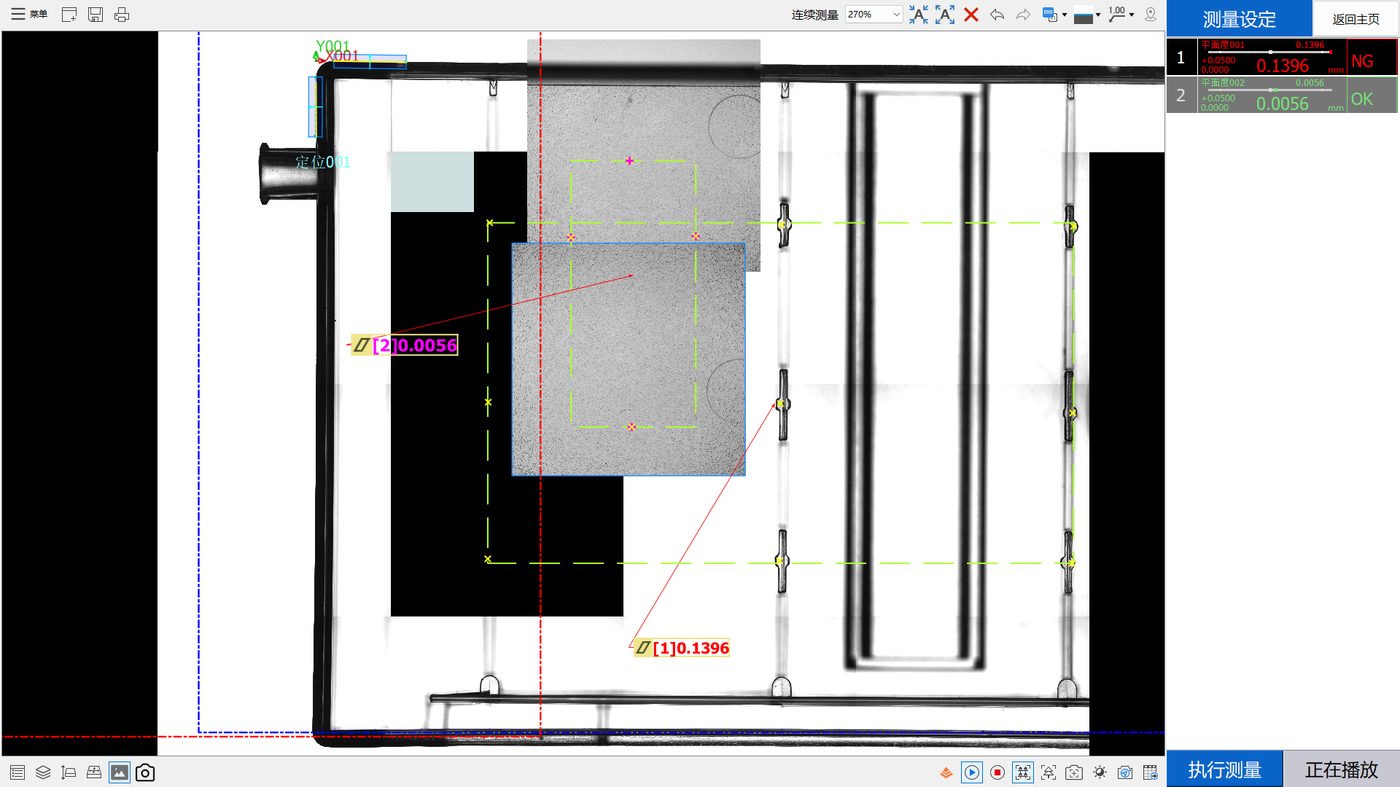
Where the routes differ
Both routes run on the same equipment platform. Taking the integrated point-spectral confocal flash measurement setup used here as an example, its measurement accuracy reaches 2 μm - so the question is not whether the equipment can deliver, but which point-collection method is more economical for the same station budget.
| Dimension | Single-point scanning | Multi-point synchronous |
|---|---|---|
| Hardware cost | Lower - one head plus motion platform | Higher - several heads and a multi-channel controller |
| Cycle time per part | Grows with point count | Largely independent of point count |
| Dependence on motion | Depends on stage accuracy and stability | Essentially no motion after clamping |
| Calibration burden | One head to calibrate | Multiple heads must be made mutually consistent |
| Flexibility | Change the path when the product changes | Head positions may need physical adjustment |
| Best suited to | First article, sampling, high-mix low-volume | High volume inline work with short cycle windows |
Working out the cycle time
Total scanning time comprises time to move between points, settling time before sampling, sampling time itself, and the overhead of acceleration and deceleration. Point count drives it upward - and often worse than linearly, because frequent starts and stops amplify the acceleration overhead.
Multi-point acquisition compresses most of that away. All points are taken together, so per-part time is dominated by loading and unloading. That is why it tends to be the only realistic option for inline measurement.
The reverse calculation applies too. If a line needs only a few dozen parts checked a day at several minutes each, spending the money on multiple heads is unlikely to pay back. One head on a decent stage is the more economical answer.
The cost people underestimate: agreement between heads
The hidden burden in multi-point schemes is that every head has to return comparable values. There are two layers: whether each head performs within its own stated figures, and whether systematic differences exist between heads.
The usual remedy is normalising all channels against a reference surface and putting a periodic verification routine in place; multi-channel software from the manufacturer typically provides tooling for it. Without that step, a multi-point distribution map can end up reflecting differences between heads rather than the part, which is considerably harder to interpret than either problem alone.
Watch the controller rather than just counting heads. POMEAS publishes 20 kHz for a single channel on its multi-channel unit and 4 kHz when sixteen channels run together. Channels and sampling rate trade off against each other directly, so design against the number of channels you will actually run concurrently.
When multi-point earns its cost
The advantages become decisive when any of the following hold: per-part inspection time is too short to allow motion at all; the surface is large and requires high point density; the product is single-variety, long-running and high volume; or the acquisition has to happen on a moving part, where scanning is simply not available.
A hybrid is also worth considering: use the stage for coarse positioning and take several points locally with a small cluster of heads in parallel. This trades between point count and cycle time and suits medium volumes over medium areas.
When single-point remains the better answer
The reverse conditions favour scanning: high-mix low-volume production with frequent changeovers; products whose geometry has not settled, so zones may still move; limited budget with relaxed timing; or genuinely small point counts, such as three locations each producing one reading.
Scanning has one further advantage that is easy to overlook: the path can be optimised later. If scatter in one area looks unstable, increase density there or add a repeat strategy. Once head positions are fixed in a multi-point fixture, changing course is considerably more disruptive.
The decision checklist
If it still feels balanced, six questions usually settle it. How many seconds per part are available? How many points need evaluating? How many product variants, and what monthly volume each? Will changeovers be frequent? What are the vibration and temperature conditions on site? Will maintenance staff be able to calibrate multiple channels? The first four weigh time and money; the last two weigh feasibility and whether it will still be running in a year.
Frequently asked questions
Can multiple heads interfere with each other?
Optical crosstalk between neighbouring heads is possible, depending on spacing, target character and optical design. The usual engineering responses are sensible spacing, staggering acquisition timing, or adjusting mounting angle. Whether interference exists in practice should be settled during prototyping.
Can I add heads later without changing the controller?
Usually not. Channel count on the controller caps how many heads connect, so expansion typically means another controller or a different model. Build future head count into the initial plan rather than discovering it later.
Why does sampling rate drop as channels are added?
Processing and transmission bandwidth inside the controller is finite, so more channels means less bandwidth each and therefore a lower rate per channel. This is normal for multi-channel controllers; always quote throughput at the concurrency you intend to run.
Can stage accuracy become the limiting factor?
Yes. Scanning results assume every point position is known and repeatable, so any positioning error or stick-slip enters the outcome. At high precision, stage accuracy and stability have to match the measurement target, with position feedback fitted where necessary.
How do you synchronise to moving parts?
Typically with an encoder or external trigger establishing the relationship between sampling instants and part position, after which the host software matches position to result. Most multi-channel controllers provide encoder inputs and trigger connections; confirm protocols and interfaces during design.
Can I keep both options open?
Yes, and it is often the sensible route. Establish the scheme first with single-point scanning - settle zones, point locations and tolerances - then revisit multi-point once volume and cycle time are known. That avoids locking the hardware shape before the product is final.
Related reading
The sensing method and its limits are covered in the transparent plastics article; the overall selection procedure has its own article.
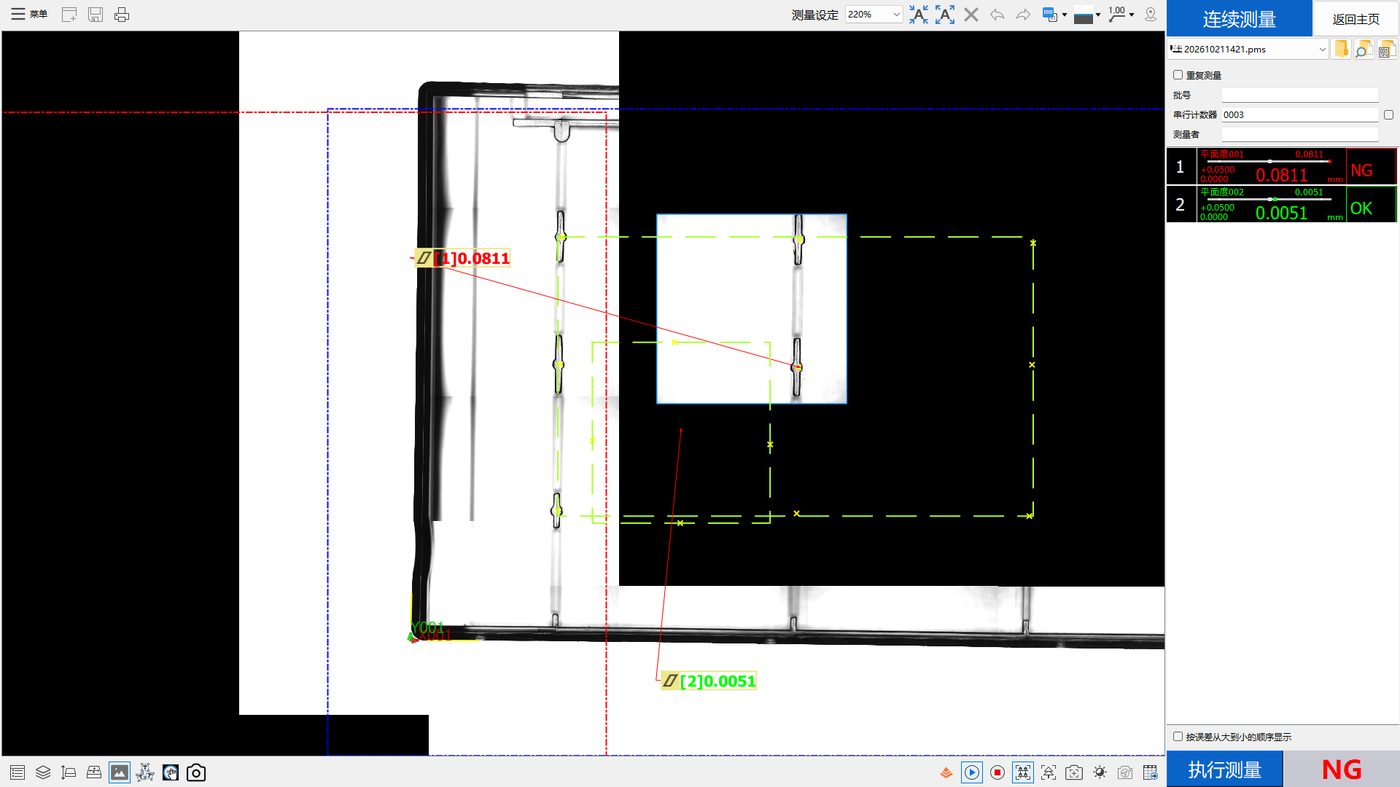
Related products and configuration notes
- 20 kHz multi-channel confocal controller - 4 / 8 / 12 / 16 head configurations; 20 kHz single channel, 4 kHz at sixteen channels
- 32 kHz four-channel confocal controller - Four channels with 32 kHz single-channel and 8 kHz four-channel synchronous operation
- SFS-D606 compact chromatic confocal sensor - 20 mm diameter body at roughly 73 g, suited to dense multi-head layouts
- POMEAS MX Automatic Vision Measuring Machine - Multi-sensor platform allowing several techniques on one machine
Related reading
- Transparent Plastic Part Flatness Inspection: What Two Data Sets Actually Show
- Two Flatness Zones, Two Opposite Verdicts on the Same Part
- Flatness Out of Tolerance: A Troubleshooting Path That Actually Works
- What Flatness Really Means, and What It Is Often Confused With
- Flatness Measurement Methods Compared: Plate, CMM, Vision, Confocal
- Repeatability Is Not Accuracy: Reading Range, Sigma and Cpk Honestly
- How to Choose Flatness Inspection Equipment: A Five-Step Reverse Method
- Point Spectral Confocal for Transparent Plastics: Benefits, Limits and Four Mistakes
- Where Warpage in Injection Moulded Parts Comes From
- Turning Inspection Data into Decisions: Four Stages of Refinement
Related POMEAS product categories
The hardware referred to above is grouped into the following categories on the product side, with the specifications and model list for each range.
- 3D White Light Interferometer / Optical Surface Profiler — 3D white light interferometer profilers for roughness, step height and flatness.

Subscribe to Our Newsletter
Simply enter your email to receive the latest news and insights from Pomeas. Stay connected with Pomeas and be the first to discover new innovations in optical excellence.