Knowledge
FOV Calculator: Field of View and Pixel Size from Sensor and Magnification
In brief: the field of view of a machine vision system follows from three numbers you already know — the sensor size, the optical magnification and the camera resolution. Enter them below to get the FOV and the object-space pixel size; if you only know the working distance and the focal length, the second mode estimates the magnification first. Everything the calculator does is two divisions — they are spelled out in the formulas so you can verify any result by hand.
Part of the POMEAS Machine Vision Optics Calculators and Formulas series — see the Machine Vision Optics Calculators and Formulas index for all 7 articles in this set, grouped by what is being calculated.
FOV and pixel size calculator
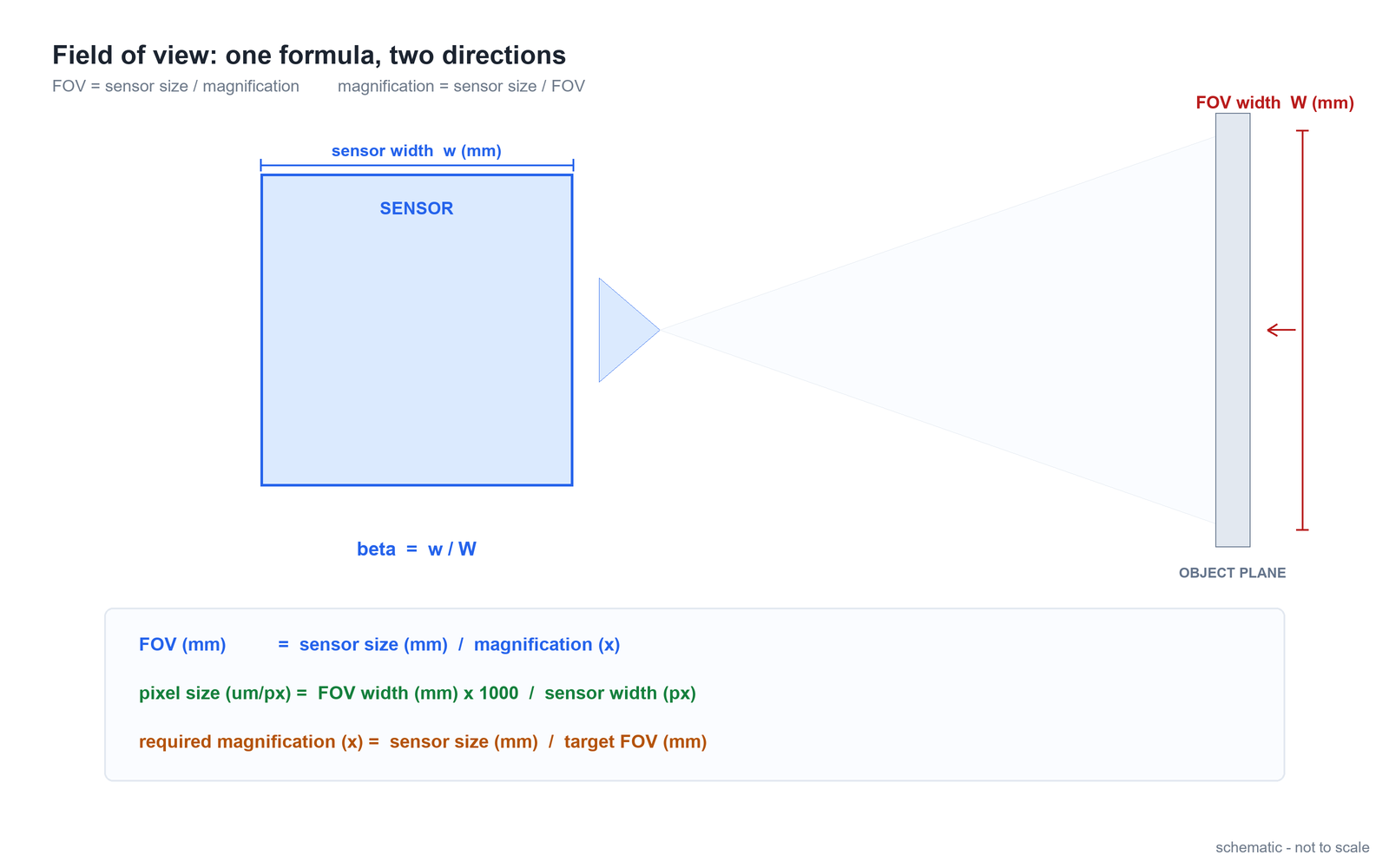
The three formulas behind the calculator
FOV (mm) = sensor size (mm) ÷ magnification (x)
pixel size (µm/px) = FOV width (mm) × 1000 ÷ sensor width (px)
required magnification (x) = sensor size (mm) ÷ target FOV (mm)
The third line runs the first one backwards: most selections actually start from the target FOV, derive the magnification, and only then go lens hunting.
Sensor format quick reference
No sensor dimensions at hand? Typical active areas by optical format (4:3, approximate — always confirm in your sensor datasheet):
| Optical format | Typical active area (mm) |
|---|---|
| 1/3" | 4.8 × 3.6 |
| 1/2.3" | 6.17 × 4.55 |
| 1/1.8" | 7.2 × 5.4 |
| 2/3" | 8.8 × 6.6 |
| 1" | 12.8 × 9.6 |
| 1.1" | 13.8 × 9.2 |
Worked examples
- Telecentric at 1X, 2/3" sensor, 5 MP camera: FOV = 8.8 × 6.6 mm; pixel size = 8800 µm ÷ 2448 px ≈ 3.6 µm/px — the classic precision-measurement starting point.
- AOI strip at 0.135X, same sensor: FOV = 8.8 ÷ 0.135 ≈ 65 × 49 mm; pixel size = 65,200 µm ÷ 2448 px ≈ 26.6 µm/px — strip-imaging territory.
- FA lens f = 50 mm at WD = 250 mm: magnification ≈ f ÷ (WD − f) = 50 ÷ 200 = 0.25X; with the 2/3" sensor that yields FOV ≈ 35 × 26 mm. Treat it as an estimate until the lens datasheet confirms it.
Where the estimate stops being exact
- Rated point. The formula assumes the lens operates at its rated magnification and WD; a zoom lens between detents or a lens focused off-design shifts the real FOV.
- Edge distortion. The nominal FOV is geometric; near the field edges, distortion bends positions even when the coverage is right.
- Principal-plane offset. Mode 2 uses a thin-lens estimate; real lenses have a finite construction length, so the effective WD differs from the flange-to-object distance.
The cheapest verification is also the most convincing: photograph a ruler at the working setup and read the true FOV from the image — one shot validates every number above.
Frequently asked questions
How do I calculate the field of view from magnification?
Divide the sensor dimensions by the optical magnification: FOV width = sensor width ÷ magnification, and the same for height. A 8.8 mm wide sensor at 1X images an 8.8 mm wide field; at 2X the field halves to 4.4 mm.
How do I calculate the pixel size on the object?
Divide the field of view width in millimetres by the sensor resolution in pixels, keeping the units straight: pixel size in micrometres = FOV width (mm) × 1000 ÷ horizontal pixels. That single number decides what your system can and cannot see.
What if I only know the working distance and the focal length?
Estimate the magnification first with the thin-lens relation, magnification ≈ focal length ÷ (working distance − focal length), then feed that magnification into the FOV formula above. It is an approximation that ignores the lens construction, so confirm the final value against the lens datasheet.
Why does the field of view change across a zoom lens range?
Because FOV and magnification are inversely proportional at a fixed sensor: the same sensor that sees 4.4 mm wide at 2X sees only about 0.18 mm at 50X — a factor of 25 across the range. That is why recipe changes on a zoom-lens station are FOV changes, and why the 2X–50X worked examples map the whole span.
Related products and reading
- Telecentric lens magnification, FOV and WD formula (0.3X–2.0X) — the same arithmetic for telecentric optics.
- FA industrial lens selection guide: sensor size, FOV, WD and accuracy — the selection chain behind these numbers.
- Industrial lenses — zoom, FA and telecentric optics rated by FOV and magnification.
- Machine vision accessories — cameras and objectives that set the sensor side of the formula.

Subscribe to Our Newsletter
Simply enter your email to receive the latest news and insights from Pomeas. Stay connected with Pomeas and be the first to discover new innovations in optical excellence.