News
6.5X Industrial Zoom Lens for Machine Vision Inspection
The LZ-63100 is the 6.5:1 member of the POMEAS industrial zoom range: 0.7× to 4.5× on a 2/3″ sensor at a working distance of 87±2 mm. Below: what the lens does, the field of view it gives at each setting, and which jobs it suits. The full range and ordering codes are in the POMEAS industrial zoom lens range.
What the LZ-63100 does
The POMEAS LZ-63100 is a high-resolution industrial zoom lens designed for machine vision inspection and automation systems. With a 6.5:1 zoom ratio and 0.7X to 4.5X optical magnification, it helps users flexibly adjust the field of view and imaging details for different inspection tasks.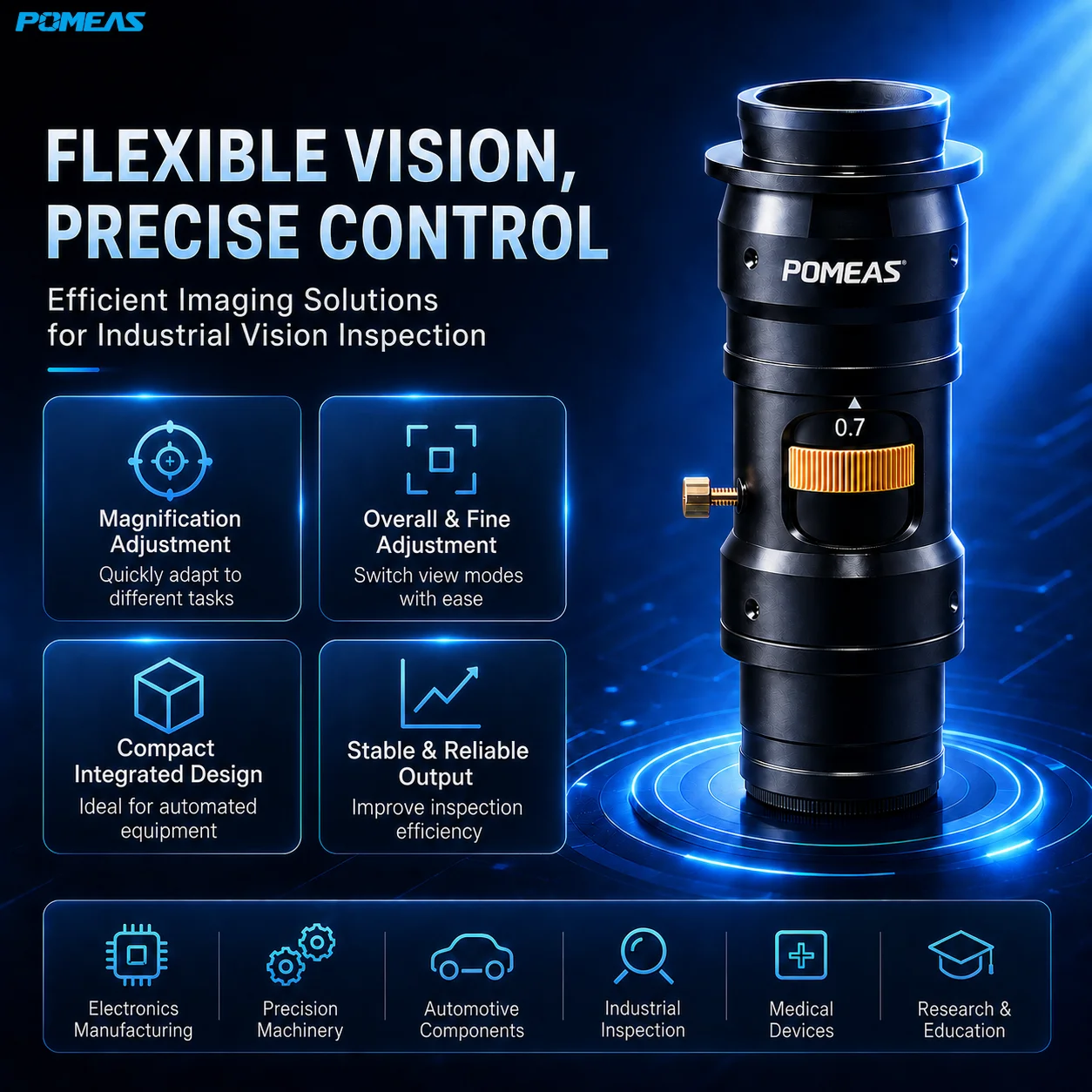
Flexible Magnification for Different Inspection Needs
In industrial inspection, different products may require different magnification levels. This zoom lens allows users to switch between a wider observation range and detailed image inspection without frequently replacing the lens. It is suitable for visual positioning, defect detection, dimensional inspection and precision component observation.
Easy Integration with Industrial Cameras
The lens supports up to 2/3" sensors and uses a C-mount interface, making it suitable for common industrial camera systems. Its compact structure is also convenient for integration into automated inspection equipment, production lines and machine vision platforms.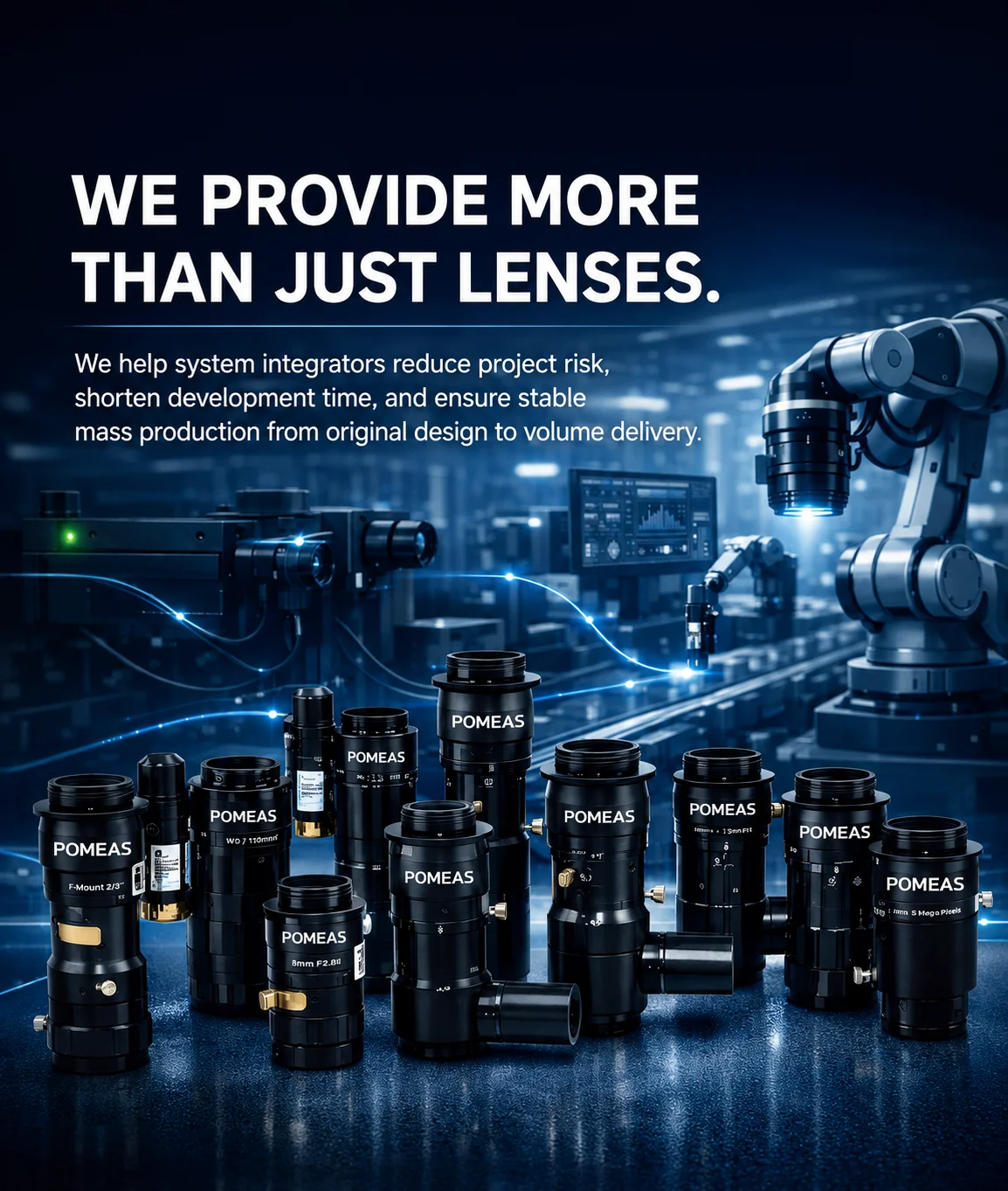
Stable Performance for Industrial Applications
With an 87±2mm working distance, the LZ-63100 provides practical installation space for lighting, fixtures and inspection objects. It can be used in semiconductor inspection, automation equipment, electronics manufacturing and communication component inspection.
Key Features
- 6.5:1 zoom ratio for flexible inspection
- 0.7X–4.5X optical magnification range
- Compatible with up to 2/3" industrial cameras
- C-mount interface for easy camera integration
- 87±2mm working distance
- Compact structure for automation equipment
- Suitable for semiconductor, electronics and precision inspection
Key Specifications
| Model | LZ-63100 |
| Product Type | High-Resolution Industrial Zoom Lens |
| Zoom Ratio | 6.5:1 |
| Optical Magnification | 0.7X–4.5X |
| Working Distance | 87±2mm |
| Maximum Compatible Sensor | 2/3" |
| Mount | C-Mount |
| Zoom Method | Manual Zoom |
Typical Applications
- Semiconductor inspection
- Electronic component inspection
- Automation equipment vision inspection
- Precision part observation
- Machine vision positioning
- Defect detection and detail inspection
Conclusion
The POMEAS LZ-63100 6.5X industrial zoom lens is a practical choice for machine vision systems that require flexible magnification, high-resolution imaging and easy camera integration. It helps inspection systems adapt to different product sizes, inspection ranges and application scenarios.
Need help choosing a suitable machine vision lens? Contact POMEAS for more industrial vision solutions.
Field of view at each magnification
Field of view is the sensor size divided by the magnification, so it scales linearly across the zoom range. On a 2/3″ sensor (8.8 × 6.6 mm), the LZ-63100 gives the following:
| Magnification | Field of view (W × H) | Sampling at 2448 px wide | Typical use |
|---|---|---|---|
| 0.7× | 12.57 × 9.43 mm | 5.1 µm/px | whole assembly in frame |
| 1.0× | 8.80 × 6.60 mm | 3.6 µm/px | part plus fixture context |
| 2.0× | 4.40 × 3.30 mm | 1.8 µm/px | feature with surrounding area |
| 3.0× | 2.93 × 2.20 mm | 1.2 µm/px | edge and burr inspection |
| 4.5× | 1.96 × 1.47 mm | 0.8 µm/px | detail only, no context |
The numbers above are arithmetic on the published magnification range and sensor size, not measured results. Two consequences follow. First, a 10 µm feature occupies 2 px at 0.7× and 12 px at 4.5×, so the magnification has to be chosen from the smallest feature that must be judged, not from the largest one that must be seen. Second, the working distance stays at 87±2 mm throughout the range, so lighting and fixturing clearance does not change as the operator zooms.
Zoom lens or fixed-focal lens: three checks before you order
A zoom trades one optimized magnification for a range of them. That trade pays off in some stations and is pure overhead in others. Three checks decide it:
- Does one station frame more than one part size? A fixed-focal lens is built around one field of view; every new part size means new optics or a new station. The LZ-63100 covers 12.57 × 9.43 mm down to 1.96 × 1.47 mm on a 2/3″ sensor (table above) without touching the optics. If every part fits in one field of view, a fixed-focal lens such as the 12mm 10MP C-mount lens stays the simpler choice.
- Is the magnification still undecided? Required sampling usually changes while inspection criteria are being finalized. A continuous zoom lets you tune framing on the real part instead of reordering optics; the LZ-63100DS9 variant adds indexed zoom positions with electronic zoom-position feedback, so a tuned setting can be reproduced across operators and shifts.
- Does one repeatable setting matter more than range? If the process is stable and only one magnification is ever used, a zoom locked at one stop adds moving optics without adding information. For a single, fixed working point, a fixed-focal design remains the simpler and lower-cost option.
Which model in this family to order
The 6.5:1 optics are shared across several mechanical variants; the differences are in how focus is set and how the lens mounts into a system.
- PMS-LZ-63100 — the base 0.7×–4.5× body described on this page, 2/3″ sensor, C-mount, working distance 87±2 mm.
- PMS-LZ-63102-M12 — 12 mm fine-focus travel, working distance 87±2 mm; the usual choice when the object plane varies slightly between parts.
- PMS-LZ63102-M3 — 3 mm fine-focus travel for the same optics, when the stand already sets coarse height.
- PMS-LZ-63107-M3 — manual 0.7×–4.5× body intended for microscope-style observation rather than inline fixturing.
If magnification has to change without an operator, the same range is available with motors: the LZ-650104 drives 0.7×–4.5× over RS-232, and the LZ650105 adds coaxial illumination for reflective parts. The trade-off between the two control schemes is set out in single-motor versus dual-motor zoom lenses, and the wider comparison of ranges in what a 6.5X or 12.5X zoom ratio means.
Frequently asked questions
Does 6.5X mean the lens magnifies 6.5 times?
No. 6.5X here is the zoom ratio: the magnification at the long end divided by the magnification at the short end, 4.5 ÷ 0.7 ≈ 6.4, which POMEAS quotes as 6.5:1. The actual optical magnification at any setting is between 0.7× and 4.5×, and that is the number to use when calculating field of view.
What field of view do I get at 0.7X on a 2/3-inch sensor?
12.57 × 9.43 mm. The calculation is 8.8 ÷ 0.7 and 6.6 ÷ 0.7. On a 1/2″ sensor (6.4 × 4.8 mm) the same setting gives 9.14 × 6.86 mm, because the field is set by the sensor, not by the lens alone.
Can this lens be used with a 1-inch camera?
No. The maximum compatible sensor is 2/3″; a larger sensor will vignette. For 1″ cameras the 4K zoom bodies in the POMEAS range are the appropriate family.
Is the LZ-63100 manual or motorized?
Manual. Magnification and focus are set by hand. The motorized equivalents in the same 0.7×–4.5× range are the LZ-650104 and the coaxial LZ650105.
What is the working distance and does it change while zooming?
87±2 mm, and it stays in that band across the whole 0.7×–4.5× range. Clearance for lighting and fixtures therefore does not have to be re-planned at each magnification.
Not sure which setting covers your part?
Send the part drawing, the smallest defect that has to be judged, and the clearance you have between lens and part. We will come back with the magnification, the field of view at that setting, and whether the 6.5:1 range is enough or a 12.5:1 body is needed. Contact POMEAS with those three numbers.

Subscribe to Our Newsletter
Simply enter your email to receive the latest news and insights from Pomeas. Stay connected with Pomeas and be the first to discover new innovations in optical excellence.