Knowledge
Single-Motor vs Dual-Motor Zoom Lens: How to Choose
The difference is not redundancy, it is which axes the machine can set by itself. A single-motor zoom lens drives magnification only, so focus stays with the operator or the fixture. A dual-motor lens drives magnification and focus, so a recipe can store both and return to both. That distinction decides changeover time, operator dependence and what the system can claim in its records. This article sets out when one motor is enough, when the second earns its cost, and what the second motor still cannot do.
What the two motors actually move
A zoom lens has two optical adjustments that matter here: the magnification group, which changes field of view and resolution, and the focus, which places the object plane at the sensor. A single-motor design drives the first. A dual-motor design drives both, usually with independent gear trains so that manipulating one does not disturb the other.
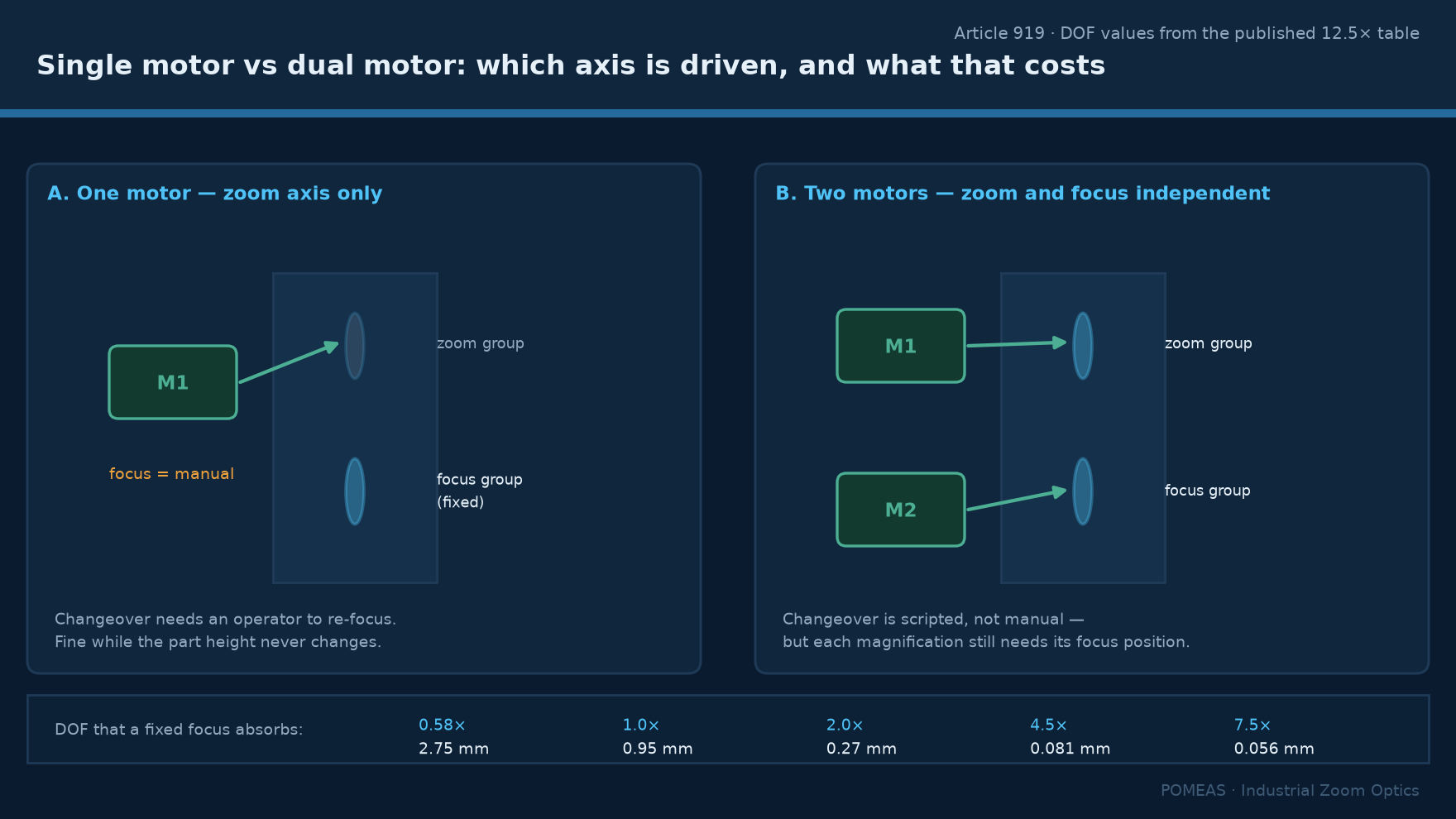
The POMEAS dual-motor 12.5× lens, PMS-LZL-12110-Z12, covers 0.58× to 7.5× on a 2/3-inch sensor with an adjustable working distance of approximately 70 ± 2 mm to 80 ± 2 mm depending on optical and focusing configuration, and is controlled over RS-232 or USB using either single-axis or dual-axis control. The single-motor PMS-LZL-12104-D1 covers the same 0.58× to 7.5× range at a fixed 77.4 ± 2 mm working distance. Same optical range, different number of controllable axes.
The real cost of one motor: changeover time
With a single-motor lens, every product change that alters magnification also alters focus, because parfocality is never perfect. The sequence becomes: recipe sets magnification, operator adjusts focus by hand, operator confirms the image. That hand step is the changeover cost, and it repeats every time magnification changes, not only at product change.
With a dual-motor lens the recipe stores magnification position and focus position together. Changeover becomes a recall rather than an adjustment. The saving is not the seconds spent turning a ring; it is that the line can run unattended and that two shifts produce the same result. Where a line changes product rarely, this saving is small. Where a line runs a high-mix schedule, it is the difference between a recipe-driven machine and a machine that always needs someone standing at it.
What the second motor still does not do
It does not autofocus. A focus motor is open-loop: it goes where it is told. If the part is 0.1 mm taller than last time, the stored focus position is wrong by 0.1 mm and the image is soft. Closing that gap requires an image metric or an external sensor, which is a separate capability. This is the single most common misunderstanding when specifying a dual-motor lens, and it is worth stating in the purchase order.
It also does not compensate for tilt. A focus axis moves along one direction; a part that is tilted rather than displaced cannot be brought fully into focus by axial motion at high magnification. At 7.5× the depth of field in the 12.5× family is 0.056 mm, so a tilt of 0.1 mm across a 1 mm field is already outside the budget.
Where depth of field decides the answer
The table below uses published depth-of-field figures for the 12.5× series and shows why the second axis matters more at the top of the range than at the bottom.
| Magnification | DOF | Height variation a fixed focus absorbs | Second axis needed? |
|---|---|---|---|
| 0.58× | 2.75 mm | Up to about ±1.3 mm | No, for most parts |
| 1.0× | 0.95 mm | Up to about ±0.47 mm | Only for tall parts |
| 2.0× | 0.27 mm | Up to about ±0.13 mm | Usually yes |
| 3.0× | 0.15 mm | Up to about ±0.075 mm | Yes |
| 4.5× | 0.081 mm | Up to about ±0.04 mm | Yes |
| 7.5× | 0.056 mm | Up to about ±0.028 mm | Yes, or a fixture |
The right-hand column is a design judgement, not a specification. A dual-motor lens is one way to absorb the middle rows; a fixture that holds height to ±0.02 mm is another, and it is usually cheaper. What the motor buys is the ability to change product without changing the fixture.
The decision in four cases
Fixed product, fixed magnification, tall tolerance. Single motor, or no motor at all. A manual lens with a fine-focus ring is the cheapest correct answer, and the 6.5× family offers 3 mm and 12 mm focus travel variants for exactly this case.
Fixed product, two magnifications, tight tolerance. Single motor for zoom plus a separate focus adjustment performed at setup. The focus position will not need to change between products, so storing it in a recipe adds nothing.
High-mix product, several magnifications. Dual motor. The recipe has to carry both axes because both change with product, and an operator-set focus would reintroduce the dependency the automation was meant to remove.
Continuous observation of varying height. Dual motor is necessary but not sufficient; a closed-loop focus is needed on top, because the second axis has no way of knowing when focus is correct.
Integration differences worth checking before ordering
A dual-motor lens has two control channels, so the controller has to support two axes. Some controllers offer a single channel and a switch, which means the two motors cannot be commanded simultaneously and the recipe has to serialise them — acceptable, but it changes the timing budget. Confirm the command set before assuming an existing single-axis controller will work, and confirm whether position can be read back per axis rather than only commanded.
Cabling is the second difference. Two motors mean two cable runs, and on a moving gantry the cable management has to accommodate both without imposing torque on the lens. A cable that pulls on the zoom ring introduces a magnification drift that no encoder can detect, because the motor is where it was told to be; the lens is not.
The third is mass. A dual-motor lens is heavier at the front of the optical path, which matters on a robot end effector where the payload budget is often already tight. The comparison of lens and camera combinations for integration is covered in motorised zoom lenses: complete selection and integration.
What to ask a supplier
Four questions separate a real dual-axis capability from a marketing claim. Can both axes be commanded in one message, or only sequentially? Can both positions be read back, and in what units? What is the backlash on each axis, and is it compensated in firmware? And what happens to focus when magnification is changed — is there a stored correction table, or does the second axis have to be re-commanded? The answers determine whether the recipe is genuinely reproducible or merely repeatable in principle.
For the test method that verifies magnification repeatability after repeated cycles, see motorised zoom lens repeatability, and for the command structure of the serial interface see motorised zoom lens RS-232 protocol.
Frequently asked questions
Does a dual-motor lens autofocus?
No. The second motor moves focus to a commanded position; it has no image feedback and cannot decide when focus is correct. Unless a separate autofocus controller or an external focus sensor is added, a dual-motor lens is open-loop on both axes.
Can I add a second motor to a single-motor lens later?
Only if the lens was designed with a focus drive train and a mounting point for it. Most single-motor lenses are built without that provision, so the upgrade path is a different lens rather than an accessory. Confirm before ordering if a future second axis is plausible.
Is a dual-motor lens worth it for one product?
Rarely. If the product and the magnification never change, the second axis is set once at commissioning and never used, so the money is better spent on a fixture that holds height repeatably. The value appears when the recipe has to recall both axes for different products.
Why does focus drift after several magnification changes?
Because the mechanical linkage between the zoom group and the focus group is not perfectly rigid, and backlash accumulates differently in each direction. A lens that drifts should be re-homed periodically, and a recipe that changes magnification frequently should include a focus verification step rather than trusting the stored position indefinitely.
What working distance does the dual-motor 12.5× lens offer?
The POMEAS PMS-LZL-12110-Z12 is specified at approximately 70 ± 2 mm to 80 ± 2 mm, adjustable depending on optical and focusing configuration. That range is shorter than the 77.4 ± 2 mm of the single-motor variant, which matters if a fixture or probe has to clear the lens.
Can one controller run both axes?
Only if it has two channels. A single-channel controller can drive the two motors in sequence but not simultaneously, which lengthens the changeover and may not suit a recipe that expects both axes to settle together. Check the channel count and the protocol before assuming compatibility.

Subscribe to Our Newsletter
Simply enter your email to receive the latest news and insights from Pomeas. Stay connected with Pomeas and be the first to discover new innovations in optical excellence.