Knowledge
Autofocus vs Motorized Zoom Lens: What Each One Solves
Autofocus and motorised zoom are often treated as the same feature, and they are not. Autofocus moves the lens to put a chosen plane in focus; motorised zoom changes magnification. One changes what part of the scene is sharp, the other changes how much of the scene is in view and how fine the detail is. A machine that needs both has two axes and two control problems, and buying one does not solve the other. This article separates the three mechanisms that are routinely confused — zoom motor, focus motor and closed-loop autofocus — and shows when each one earns its place.
Three mechanisms, not two
Zoom motor. Drives the magnification ring. Its job is to change field of view and resolution, and its quality measure is repeatability of magnification, not speed. A zoom motor does not improve focus at all.
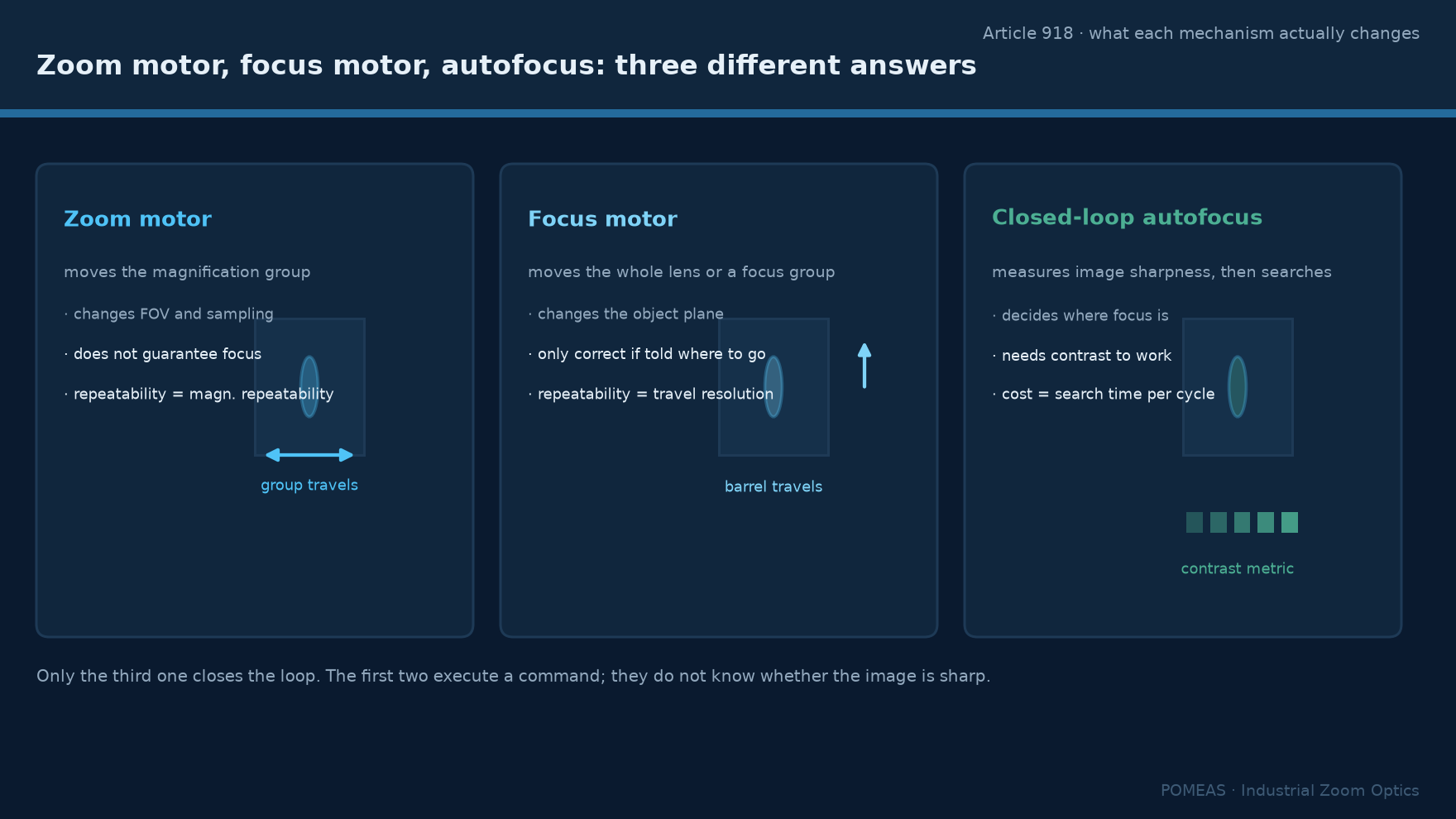
Focus motor. Drives the focus ring or moves the camera along the optical axis. Its job is to place the object plane at the sensor, and its quality measure is resolution of travel: how small a step it can make. A focus motor is open-loop unless it is paired with feedback, and open-loop focus is only as good as the mechanics.
Closed-loop autofocus. Uses an image metric — contrast, sharpness, or a projected pattern — to decide when focus is correct, and drives the focus axis until the metric peaks. It is a control loop, not a mechanism, and it can be built on top of a focus motor or on a dedicated AF unit.
| Mechanism | What it changes | Quality measure | Does it fix focus? |
|---|---|---|---|
| Zoom motor | Magnification, field of view, sampling | Magnification repeatability | No |
| Focus motor | Position of the object plane | Travel resolution, backlash | Only if told where to go |
| Closed-loop autofocus | Nothing optical — it decides where focus is | Search time, lock reliability | Yes, on a surface with contrast |
Most confusion comes from products that bundle the second and third. A vendor saying "autofocus lens" usually means a lens with a focus motor plus a controller running an image-based search, and the performance difference between two such products is almost entirely in the search algorithm and the mechanics, not in the optics.
Why depth of field makes this unavoidable
In the POMEAS 12.5× motorised series, published depth of field falls from 2.75 mm at 0.58× to 0.056 mm at 7.5×. At the low end a part can be 2 mm out of position and still be sharp. At the high end a 0.05 mm error is the entire budget. A system that inspects at both magnifications therefore has a focus problem only at the high end, which is why a single fixed focus position is a defensible design at low magnification and indefensible at high.
This also explains why autofocus is not a luxury at high magnification: it is the only practical way to absorb part-to-part height variation smaller than the depth of field. If the part is fixtured flat and the height is repeatable to better than 0.02 mm, open-loop focus is enough. If the part is a moulded housing with 0.1 mm height variation, it is not.
The search cost, and why it matters more than the hardware
An image-based autofocus search does not know where focus is; it estimates. A typical implementation moves in steps, evaluates a sharpness metric at each, and refines around the peak. The cost is the number of frames multiplied by exposure time plus the settle time per step. With a 20 ms exposure and 15 steps, the exposure cost alone is 300 ms, and settle time usually exceeds it.
Two design choices cut this substantially. First, bound the search: if part height is known within ±0.3 mm, search that range rather than the full travel. Second, reuse the last good focus position as the starting point when the part type is unchanged, which turns a full search into a verification. Both are software decisions, not hardware purchases, and they usually matter more than the motor's step size.
Where autofocus fails regardless of implementation
Image-based autofocus needs a scene with contrast that changes with defocus. Three surfaces break that assumption. A bare polished wafer has almost no texture, so every focus position looks equally flat and the search either stalls or locks onto a dust particle. A transparent layer produces an interference pattern whose contrast does not peak at the surface an engineer cares about. A highly repetitive pattern such as a dense line grating produces multiple local maxima, so the search can lock one period away.
For these cases the alternatives are a focus sensor that does not use image contrast — laser triangulation or a confocal probe — or a mechanical reference such as a nozzle that touches the surface before measurement. The optics are not at fault and changing the lens will not help.
Zoom and focus interact through parfocality
A zoom lens that is perfectly parfocal holds focus across the whole magnification range. No production lens is perfect, so a magnification change introduces a small focus error that grows with the size of the change. That means a recipe which changes magnification must re-focus afterwards, whether by autofocus or by a stored correction. The tolerance and the adjustment procedure are described in motorised zoom lenses: complete selection and integration.
This is the practical reason a dual-axis system exists: one axis for magnification, one for focus, both under recipe control. A single-axis system that moves only magnification leaves the operator to correct focus by hand after every change, which defeats the purpose of automating the change.
Choosing between them: four questions
Does magnification change inside the recipe? If yes, a zoom axis is required. Autofocus does not change field of view.
Does part height vary by more than the depth of field at the working magnification? If yes, a focus axis is required, and if the variation is unpredictable, closed-loop autofocus is the practical form.
Is the surface low-contrast, transparent or repetitive? If yes, image-based autofocus will be unreliable and a non-optical focus reference is needed.
Does the record need to state the magnification? If yes, the zoom axis must report position. A manual ring cannot.
The answers map onto product configurations rather than onto a single "best" choice. A manual zoom lens with a fine-focus ring covers the case where a person changes both. A single-motor lens covers magnification under recipe control with a fixed focus. A dual-motor lens covers both under recipe control. A microscope unit with an integrated AF module covers observation where focus must track a surface continuously.
Where this lands in a real system
For a semiconductor or microelectronics station, the sequence that works is: move to a coarse magnification, find and centre the feature, switch to the measuring magnification, autofocus within a bounded range, then measure. Zoom before focus, never the other way, because a magnification change invalidates the focus position.
For a bench application, the sequence is manual: zoom, then trim focus with the ring. That is why the POMEAS 6.5× family includes 3 mm and 12 mm fine-focus variants, such as the PMS-LZ-63102-M12 — the mechanism exists so that a person can correct a small parfocal error quickly without a controller.
For continuous observation of a moving surface, neither a zoom nor a focus motor alone is sufficient; the system needs a tracking focus loop, and the trade-offs are described in build a motorised digital microscope: zoom, APO, autofocus.
What none of these mechanisms do
Autofocus does not improve resolution. It puts the image plane where it belongs; the smallest resolvable feature is still set by numerical aperture, which is fixed at a given magnification. A system that autofocuses perfectly at 7.5× still cannot resolve below 3.05 µm in the 12.5× family. Motorised zoom does not improve depth of field: raising magnification shrinks it, and no control strategy changes that. And neither mechanism compensates for a part that is tilted rather than displaced, because a focus axis moves along one direction only.
Frequently asked questions
Is a motorised zoom lens the same as an autofocus lens?
No. A motorised zoom lens changes magnification under control; autofocus changes focus position using image feedback. A lens can have either, both, or neither. Buying a zoom motor does not add focus capability, and buying autofocus does not add magnification control.
Can autofocus replace a focus motor?
Autofocus is a control strategy built on top of a focus actuator, so it does not replace the motor — it depends on it. What autofocus replaces is the need for a human or a recipe to know the correct focus position in advance.
Why does my autofocus hunt on a shiny wafer?
Because the sharpness metric has no strong peak on a low-texture, specular surface, so small changes in position produce almost no change in the metric. Options are to add a reference mark, use oblique illumination to create texture, or use a non-optical focus sensor.
How long should an autofocus search take?
It is set by the number of frames times exposure plus settle time, not by a fixed specification. A 15-step search at 20 ms exposure costs at least 0.3 s in exposure alone. Bounding the search range and starting from the last good position are the two effective ways to shorten it.
Do I need autofocus at 0.58×?
Rarely. Depth of field at that magnification is 2.75 mm in the 12.5× family, which absorbs most realistic height variation. Autofocus matters where depth of field approaches the height tolerance, which in practice means 3× and above.
What is the difference between a detented zoom and an encoded zoom?
A detented zoom clicks into defined magnification positions, so the step is identifiable. An encoded zoom reports a continuous position back to the controller, so any magnification in range can be reproduced. For a recipe with fixed steps, detents are simpler to validate; for a scanning recipe, an encoder is necessary.

Subscribe to Our Newsletter
Simply enter your email to receive the latest news and insights from Pomeas. Stay connected with Pomeas and be the first to discover new innovations in optical excellence.