Knowledge
Why Does an Image Turn Blurry After Adding a Prism? Four Causes and the Order to Check Them
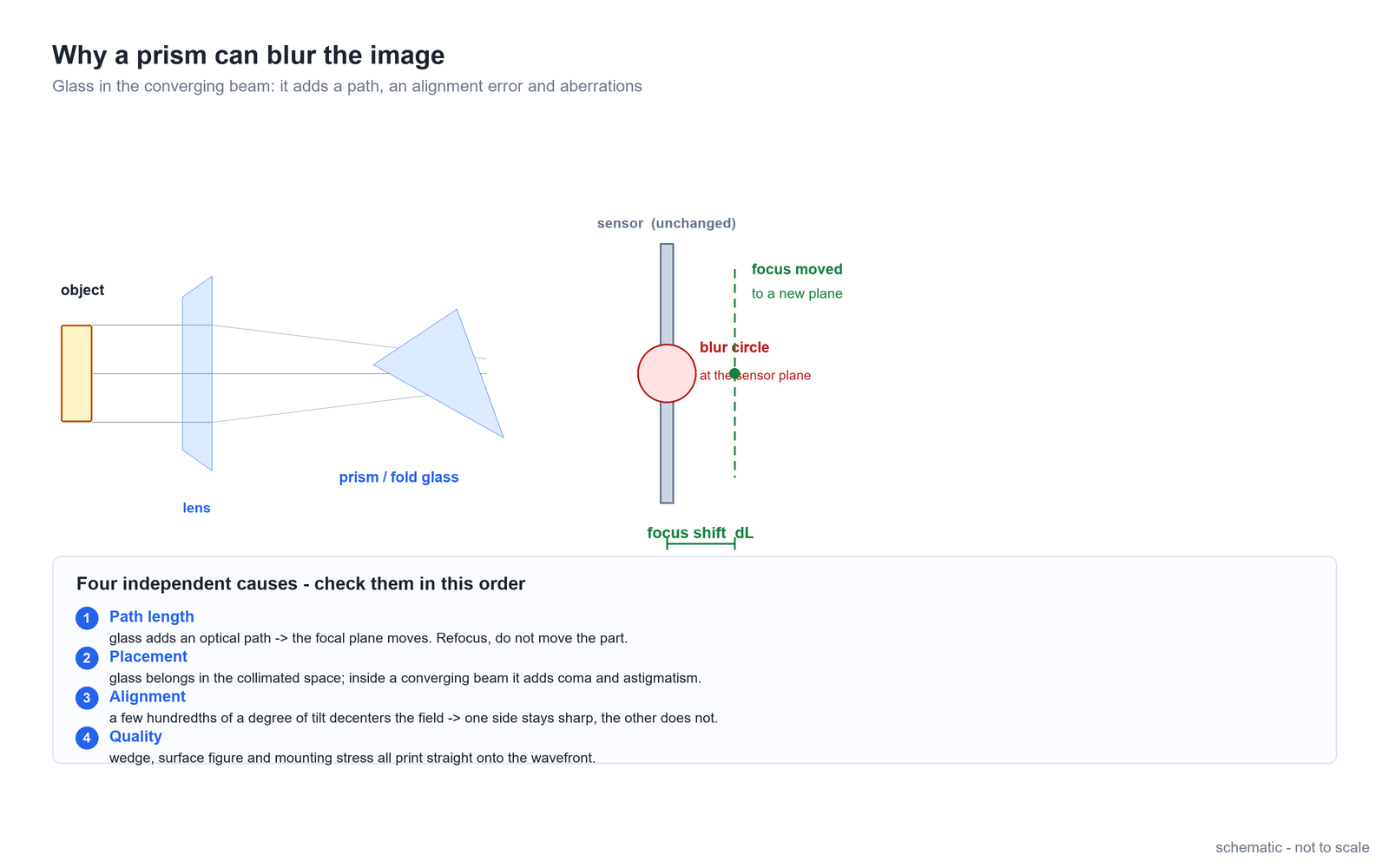
In brief: a prism (or any plane glass block) inserted into a machine vision path changes the optical system, and the blur that follows almost always comes from one of four independent causes: the glass adds optical path length, the glass sits in the wrong kind of beam space, the glass is misaligned, or the glass itself is not good enough. They produce different symptoms, so they can be told apart — and checked in a fixed order — instead of being chased by trial and error.
First, what the prism is doing in the path
In machine vision, prisms and plane-parallel glass plates appear for two very different reasons. As a fold, they bend the optical path by 90° so a long working distance fits inside a compact housing — the same job as a fold mirror, with the beam travelling inside glass instead of air. As an optical component, they split or recombine light — a beam-splitter cube feeding coaxial illumination is the most common example, and it sits directly in the imaging path. Both uses are legitimate. Both also mean the imaging lens is no longer working in the conditions it was designed for, and blur is the usual first symptom.
Cause 1 — the glass adds optical path length, so the focal plane moves
Light travels more slowly in glass, so a thickness t of glass behaves, optically, like a longer air path. The standard engineering relation for a plane-parallel plate in a converging beam is:
Focus shift ≈ t × (1 − 1/n) — n = refractive index of the glass; general geometric relation, not a datasheet value.
For n ≈ 1.5, every 10 mm of glass pushes the best-focus plane roughly 3.3 mm further from the lens. If the sensor does not move with it, the system is simply defocused — uniformly, over the whole field. The same logic applies in the object space: an object seen through a glass window appears farther away by the same factor, so a lens set to a nominal working distance defocuses as soon as a window or prism is placed in front of it.
Symptom: the whole image blurs equally, and focusing the lens (or moving the camera) makes it sharp again. Fix: re-focus — do not conclude that the prism "ruined" the lens.
Cause 2 — the glass sits in the wrong kind of beam space
A plane-parallel plate is nearly harmless in a collimated (parallel) beam: it shifts the path but adds essentially no aberration on axis. In a converging beam — the cone between the lens and the sensor — the same plate is not neutral: it introduces spherical aberration that grows steeply with the cone's steepness, and if the plate is tilted, it adds astigmatism as well.
This is why placement matters more than people expect. A fold prism belongs where the beam is parallel (between lens and collimated space, or on the collimated side of the system). A beamsplitter cube has no choice — it must sit in the converging cone — which is exactly why coaxial-illumination designs are engineered as a set rather than improvised: the imaging lens must be specified to tolerate glass in its image space.
Symptom: refocusing helps but never fully recovers sharpness; the blur is worse at high magnification or wide aperture, where the cone is steepest. Fix: move the glass to collimated space if the design allows, or use optics specified for glass in the image path.
Cause 3 — alignment: tilt and decenter print asymmetric errors
A prism that is tilted or shifted does not blur the field uniformly — it decenters the image and tilts the focal plane, so one side of the field stays sharp while the other goes soft, and a straight part can be imaged with a slight keystone. For a fold prism the tolerance is unforgiving: a deviation of a few hundredths of a degree is already visible as image shift at high magnification, and any residual wedge angle in the glass compounds it by bending the beam a little on every surface.
Symptom: sharpness varies across the field; the image shifts when the prism is nudged; sharpness changes when the prism is rotated in its mount. Fix: align the prism, then verify by rotating it — a well-aligned fold leaves the image stationary.
Cause 4 — the glass itself: wedge, surface figure and mounting stress
Finally, the component quality sets a floor that no alignment can beat. Bulk wedge (surfaces not parallel) deflects the beam. Poor surface figure adds wavefront distortion that the imaging lens cannot remove. And an over-tightened mount can stress the glass — a real effect in stressed optics, which shows up as localised blur near the mounting points. These defects do not average out with refocusing; they print straight onto the wavefront.
Symptom: blur or distortion survives refocusing and re-alignment, and moves with the component when it is swapped for another of the same type. Fix: qualify the component — request the wedge and surface-figure specifications before integrating, not after.
The check order, condensed
- Refocus first. If a focus adjustment restores full sharpness, it was cause 1 and the integration just needs the new focal plane.
- Map the field. Sharp everywhere except one region points to alignment (cause 3); uniformly soft after refocusing points to placement (cause 2).
- Rotate the prism. If sharpness changes with rotation, the mount or the wedge is involved.
- Swap components. If a second, identical prism reproduces the defect, the design (not the individual part) is at fault — go back to cause 2.
For a real integration case of folded zoom optics — where the module, the fold and the working distance have to agree — see the fold-mirror integration case, and for keeping focus behaviour predictable after magnification changes, see the parfocality and centering procedure.
Frequently asked questions
Does adding a prism change the working distance I need to set?
Yes, in effect. Glass in the object space makes the object appear farther away, and glass in the image space moves the focal plane. Either way the mechanical distance that gave a sharp image without the prism will not give one with it — re-focus or re-set the distance after the glass is installed.
Can I put a prism anywhere in the optical path?
No. A plane-parallel element is close to neutral in collimated space but introduces aberrations inside a converging beam. Whenever the design allows, place fold glass where the beam is parallel; if the glass must sit in the cone (as with a beamsplitter), the imaging optics must be specified for it.
Why is only one side of my image blurry after adding a prism?
That is the signature of tilt or decenter: the focal plane is no longer parallel to the sensor, so sharpness varies across the field. Align the prism and verify by rotating it — a correctly seated fold leaves the image stationary as it turns.
The image is still soft after refocusing and aligning — what is left?
Then the remaining suspects are the component itself: wedge, surface figure or mounting stress. Swap in another unit of the same type; if the defect follows the component, request its optical specifications (wedge angle, surface figure) and qualify it before further integration. For a structured checklist, contact our engineering team.
Related products
- Industrial lenses — zoom and telecentric optics specified for integration into folded or beamsplitter paths.
- Machine vision accessories — cameras, mounts and auxiliary optics for compact imaging chains.
- Microscopes and surface profilers — complete optical systems where beam folding is engineered, not improvised.

Subscribe to Our Newsletter
Simply enter your email to receive the latest news and insights from Pomeas. Stay connected with Pomeas and be the first to discover new innovations in optical excellence.