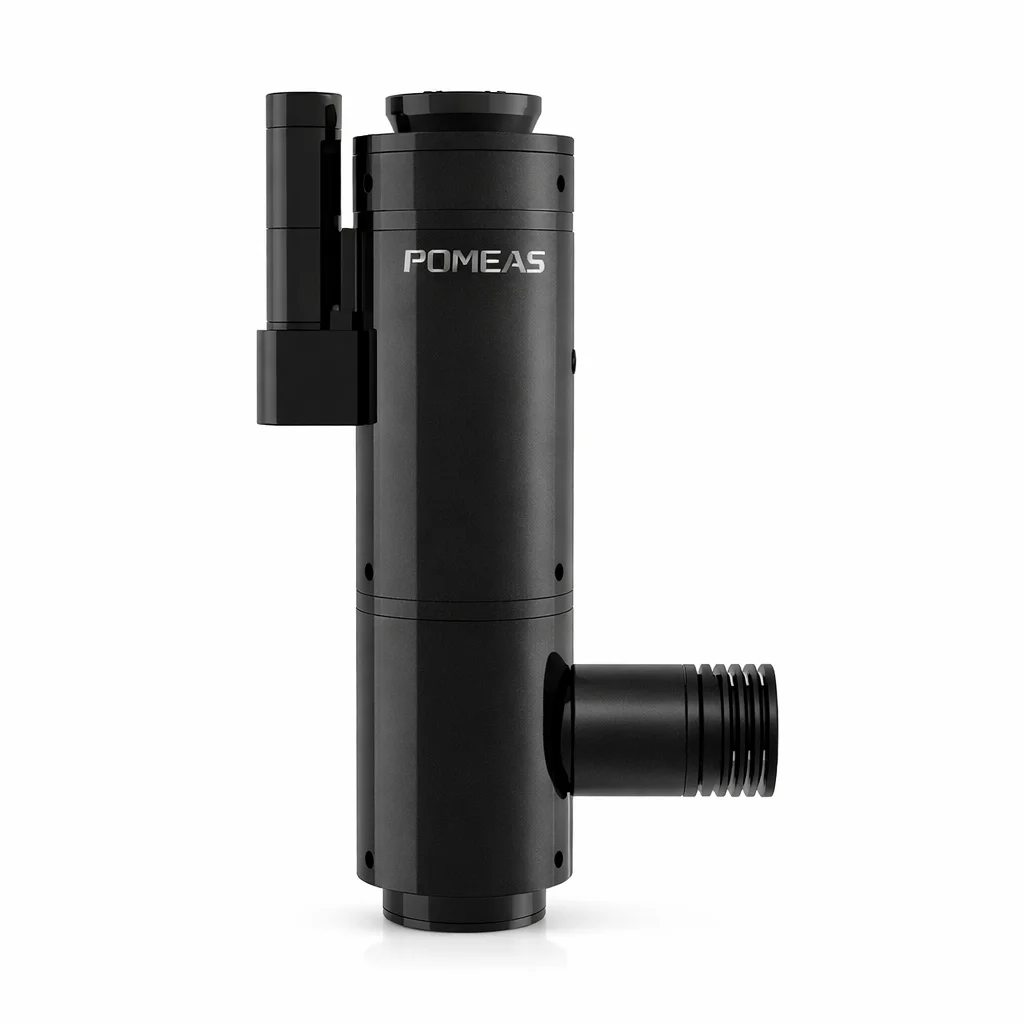
How to Calculate Zoom Lens FOV: Sensor, Magnification and Field of View
When selecting a machine vision zoom lens, customers often ask first: "how much can this lens see?" That question is really about the lens FOV, the field of view.
For a continuous zoom lens, FOV is not a fixed value. Once the magnification changes, the actual observation range changes with it. In general:
- lower optical magnification → larger FOV;
- higher optical magnification → smaller FOV.
The two core parameters that determine the actual FOV are the effective camera sensor size and the current optical magnification of the lens. So when selecting a zoom lens, you should not only ask "is this a 6.5X or a 12.5X", but first define the maximum FOV and minimum FOV the project needs.
1. What is FOV?
FOV stands for field of view. In machine vision it usually means the object-side area the camera actually sees through the lens. For example, if a vision system actually sees 12.57 mm × 9.43 mm, then the horizontal FOV is 12.57 mm and the vertical FOV is 9.43 mm. Some lens datasheets also give a diagonal FOV.
For example, in POMEAS 6.5X continuous zoom lens data, with a 2/3" camera at 0.7X magnification the listed FOV is 15.71 × 12.57 × 9.43 mm, corresponding to a diagonal FOV of 15.71 mm, a horizontal FOV of 12.57 mm and a vertical FOV of 9.43 mm.
For a real inspection project the horizontal and vertical FOV matter most, because those two determine whether the product fits fully into the image.
2. How is zoom lens FOV calculated?
If the effective sensor size and the object-side optical magnification of the lens are known, the following relationships give a basic estimate:
horizontal FOV = effective sensor width ÷ optical magnification
vertical FOV = effective sensor height ÷ optical magnification
where horizontal FOV is the horizontal field, vertical FOV is the vertical field, sensor width and sensor height are the effective dimensions of the camera sensor, and magnification is the current object-side optical magnification.
This formula matters because it links three parameters directly: sensor, optical magnification and FOV. Knowing two of them lets you estimate the third. Note that this is the basic optical relationship used in machine vision projects; the final engineering selection should still be confirmed against the specific lens datasheet and actual imaging results.
3. Example: a 2/3" camera with a 0.7X lens
We can verify this directly using the real data in POMEAS 6.5X continuous zoom lens documentation. The typical magnification range of the series is 0.7X to 4.5X.
With a 2/3" sensor, the datasheet gives the horizontal and vertical field of view at 0.7X as approximately 12.57 mm × 9.43 mm. Using the effective imaging area of about 8.8 mm × 6.6 mm:
- horizontal FOV: 8.8 ÷ 0.7 ≈ 12.57 mm;
- vertical FOV: 6.6 ÷ 0.7 ≈ 9.43 mm.
This matches the FOV given in the lens data. So at the low-magnification end the lens can see a relatively larger object-side area.
4. What is the FOV at 4.5X?
The camera is unchanged, using the same sensor size, but the lens is adjusted from 0.7X to 4.5X:
- horizontal FOV: 8.8 ÷ 4.5 ≈ 1.96 mm;
- vertical FOV: 6.6 ÷ 4.5 ≈ 1.47 mm.
So the actual FOV at 4.5X is approximately 1.96 mm × 1.47 mm. POMEAS 6.5X product data give the same result: 2.44 × 1.96 × 1.47 mm, where 2.44 mm is the diagonal field, 1.96 mm the horizontal field and 1.47 mm the vertical field.
This shows the characteristic of a continuous zoom lens very clearly: as magnification rises from 0.7X to 4.5X, the FOV narrows substantially and the same target occupies a larger proportion of the image. With the same sensor, low magnification gives a large FOV and high magnification a smaller local FOV.
5. FOV at different magnifications on a 6.5X lens
Using a POMEAS 6.5X continuous zoom lens with a 2/3" camera makes the relationship between magnification and FOV easy to see.
| Optical magnification | Horizontal FOV (mm) | Vertical FOV (mm) |
|---|---|---|
| 0.7X | 12.57 | 9.43 |
| 1.0X | 8.80 | 6.60 |
| 1.5X | 5.87 | 4.40 |
| 2.0X | 4.40 | 3.30 |
| 2.5X | 3.52 | 2.64 |
| 3.0X | 2.93 | 2.20 |
| 3.5X | 2.51 | 1.89 |
| 4.0X | 2.20 | 1.65 |
| 4.5X | 1.96 | 1.47 |
From the table it is clear that as the lens magnification rises, the FOV shrinks step by step. A continuous zoom lens can therefore achieve, with one camera and lens assembly: search over a wide field → locate at a medium magnification → examine detail at high magnification. That is a major reason zoom lenses are used in automation, multi-spec inspection and industrial observation.
6. Working backwards from FOV to the magnification you need
In real machine vision projects the more common selection question is not "I have a 2X lens, how much can it see?" but "I need to see a 10 mm area, what magnification should I use?"
The formula can then be reversed:
required magnification ≈ sensor width ÷ required horizontal FOV
or: required magnification ≈ sensor height ÷ required vertical FOV.
For example, with an effective sensor width of 8.8 mm and a project requirement to see 10 mm horizontally:
8.8 ÷ 10 = 0.88X
so the lens must be able to work at around 0.88X. If the project also requires the horizontal field to narrow to 2 mm:
8.8 ÷ 2 = 4.4X
so the project needs an actual optical magnification coverage of roughly 0.88X to 4.4X. With that in hand, judging between a 6.5X, 12.5X or other lens is more sensible than simply comparing which zoom ratio is larger. Once the maximum and minimum FOV are calculated, the next step is to combine working distance, sensor, resolution and control requirements to choose the motorized zoom lens.
7. Does a larger sensor mean a larger FOV?
At the same lens magnification, and provided the lens image plane fully covers the sensor, a larger sensor normally delivers a larger FOV. For example, using the same 1.0X lens, if the effective sensor width is 8.8 mm the horizontal FOV is about 8.8 mm; switching to a smaller sensor reduces the imaging area actually used, so the FOV shrinks with it.
POMEAS 6.5X lens data also list different FOV values for 2/3", 1/2" and 1/3" cameras, and state a maximum compatible sensor of 2/3". So when a customer says "I want a 2X lens", that alone is not enough to calculate the FOV. The camera sensor size must be known as well.
8. Why you cannot use "2/3 inch" directly in the calculation
This is a very common mistake in machine vision lens selection. Many people see a camera marked 1/3", 1/2", 2/3", 1" or 1.1" and convert the inch figure straight into millimetres for the FOV calculation. That method is usually inaccurate.
The inch designation of a sensor is an industry optical format name and cannot be used directly as the actual width, height or diagonal of the sensor in an FOV calculation. For FOV work it is better to read the sensor width and sensor height from the camera datasheet, or to calculate the effective sensor size from the pixel size multiplied by the effective pixel count. For example, the horizontal sensor size can be obtained as horizontal effective pixel count × pixel size. Only a sensor size calculated this way is suitable for FOV calculation.
9. How do 6.5X, 12.5X and FOV relate?
6.5X and 12.5X denote the zoom ratio, not the FOV and not the actual optical magnification at one fixed position of the lens.
POMEAS 6.5X series have a typical magnification range of 0.7X to 4.5X. POMEAS 12.5X series data state a magnification range of 0.58X to 7.5X. The 12.5X series covers both a lower low end and a higher high end, so it can cover a wider FOV variation range. In POMEAS 12.5X data, with a 2/3" camera, the stated FOV coverage is approximately 1.467–18.333 mm.
This does not mean a project should necessarily choose 12.5X. If the maximum and minimum FOV the project actually needs can already be covered by a 6.5X lens, there is no need to change the plan merely because 12.5X has a wider range. If you are still unclear what 6.5X and 12.5X mean, continue with What do 6.5X and 12.5X mean?
10. How much larger than the workpiece should the FOV be?
In theory, as long as the FOV is larger than the workpiece, the workpiece can enter the image. In real projects, however, it is usually not advisable to make the workpiece exactly fill the field of view. Reasons include: loading position variation, product size tolerance, mechanical mounting error, the background area the algorithm may need, and the imaging margin normally reserved at the edges.
For example, if the part is actually 10 mm × 6 mm, the FOV should generally not be designed as exactly 10 mm × 6 mm. A reasonable margin should be allowed according to the actual positioning error and inspection requirement. How much margin is needed should be determined from the product positioning accuracy, the motion mechanism and the vision algorithm, rather than a single fixed percentage.
11. How does FOV relate to pixel accuracy?
FOV determines not only how much can be seen, but also how many pixels a target occupies in the image. For example, if the camera has 2448 effective pixels horizontally and the horizontal FOV is 12 mm, each pixel corresponds to approximately:
12 ÷ 2448 ≈ 0.00490 mm/px, that is about 4.90 µm/px
If the FOV is narrowed to 6 mm: 6 ÷ 2448 ≈ 2.45 µm/px.
So, with the camera resolution unchanged, a smaller FOV means a smaller object-side dimension per pixel. This is why a high magnification and a small FOV are usually better suited to observing small details. Note, however, that the per-pixel object-side dimension does not equal the final measurement accuracy and does not equal the true optical resolution of the lens. The smallest defect that can be identified also depends on lens resolution, numerical aperture, target contrast, illumination, algorithm and system stability.
12. Why the actual FOV may differ from the calculated value
The FOV formula is well suited to early feasibility estimates, but the final imaging result may still differ from the theoretical value. Common reasons include: the actual lens magnification differing from the specification by a tolerance; differences in the actual effective sensor size between cameras; ROI or camera cropping changing the pixel range actually used; the real working distance differing from the design working distance; lens distortion affecting the geometric relationship at different positions; and additional optical accessories such as magnification lenses or TV tubes in the system.
FOV calculation is therefore suitable for initial lens selection, and the final project should be based on the specific datasheet, actual imaging and calibration results.
13. How should the calculation be done in a real selection?
For a continuous zoom lens project, a reasonable selection order is:
- confirm the largest dimension of the inspected product;
- determine the largest FOV that has to be observed;
- determine the smallest FOV that has to be observed;
- confirm the actual effective camera sensor size;
- back-calculate the minimum required magnification from the largest FOV;
- back-calculate the maximum required magnification from the smallest FOV;
- judge whether a 6.5X, 12.5X or other lens covers that magnification range;
- then confirm working distance, resolution, depth of field, illumination and the mounting structure.
For example: effective sensor width 8.8 mm, maximum horizontal FOV 12 mm, minimum horizontal FOV 2 mm. The minimum required magnification is about 8.8 ÷ 12 ≈ 0.73X, and the maximum required magnification about 8.8 ÷ 2 = 4.4X. The project needs an optical magnification coverage of roughly 0.73X to 4.4X. Matching that against the magnification specifications of real continuous zoom lenses narrows the selection range quickly.
After the FOV and magnification calculation, still check sensor compatibility, working distance, resolution, control method and illumination structure. Continue with the motorized zoom lens selection guide for the full workflow.
14. FAQ
What is the simplest FOV formula for a lens? When the object-side optical magnification is known: horizontal FOV ≈ effective sensor width ÷ optical magnification; vertical FOV ≈ effective sensor height ÷ optical magnification.
How much can a 0.7X lens with a 2/3" camera see? It depends on the specific camera sensor size and lens specification. Using the POMEAS 6.5X lens data in this article as an example, a 2/3" camera at 0.7X gives a horizontal × vertical FOV of approximately 12.57 × 9.43 mm.
How much can a 4.5X lens with a 2/3" camera see? Using the POMEAS 6.5X lens data in this article, the horizontal × vertical FOV at 4.5X is approximately 1.96 × 1.47 mm.
Does higher magnification mean a larger field of view? No, usually the opposite. With the sensor unchanged, higher magnification gives a smaller FOV and lower magnification a larger FOV.
Does a camera with more pixels have a larger FOV? Not necessarily. The FOV is mainly determined by the effective physical sensor size and the lens magnification. More pixels mainly means more sampling points within the same FOV, and does not necessarily mean a larger FOV.
Does a larger sensor always mean a larger FOV? At the same lens magnification, and provided the lens image plane fully covers the sensor, a larger effective sensor usually delivers a larger FOV. But if the sensor exceeds the image plane the lens is designed to support, vignetting or edge degradation can appear, so the sensor cannot simply be enlarged indefinitely to gain FOV.
Can lens magnification be back-calculated from the FOV? Yes. The basic relationship is required optical magnification ≈ sensor size ÷ required FOV. This is a very practical method for initial machine vision zoom lens selection.
Why does the FOV in a datasheet differ slightly from my own calculation? It may relate to the actual lens magnification, effective sensor size, working distance, optical accessories and product design parameters. Calculated values suit early selection; the final result should follow the specific lens datasheet and actual imaging tests.
I already know the maximum and minimum FOV — what next? Back-calculate the required minimum and maximum optical magnification from the sensor size, then judge whether a 6.5X, 12.5X or other continuous zoom lens covers that range. After that, still check working distance, sensor compatibility, resolution, depth of field, illumination and motorized control requirements.
Not sure what magnification your camera should use? You do not need to decide between 6.5X and 12.5X first. A more effective approach is to calculate the maximum and minimum FOV the project needs first. With the camera model, sensor size, product size, maximum FOV, minimum FOV, working distance and smallest feature to observe, POMEAS can calculate the required optical magnification range and match a suitable continuous zoom lens.